
Genealogy

Reality Check

John Basquinn in 1920 United States Census
1920 U.S. census, population schedule, Manhattan Assembly District 16, New York, New York, enumeration district (ED) 1127, sheet 11A, p. 243 (hand written), dwelling 16, family 290, John Basquinn; digital images, Ancestry (http://www.ancestry.com/ : accessed 17 Sep 2017); citing National Archives and Records Administration microfilm T625, roll 1214. Rec. Date: 8 Oct 2016
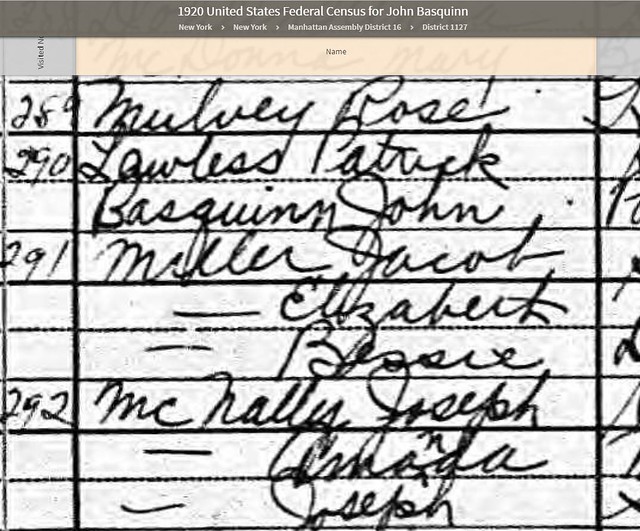
Here’s another tip: Before disregarding a record because it has the wrong name on it, consider if that name makes any sense. Basquin/Basquinn is not a name you’d find in Ireland. It simply doesn’t exist. If you search the Irish census records, you won’t find the name, period. If you search Ancestry globally for basquin* born Ireland, you will find a handful of records, all of which are either transcribed incorrectly or you can see that an enumeration mistake was made and the country of origin was France.

For example: In the 1860 US census there’s a Kate with no last name given, born Ireland, working in New Orleans as a servant in the home of a French family named Basquin. I’d bet money her name was not Basquin, but whoever the informant was had no idea what her surname was and likely didn’t care. She was just a servant, right? Then when the record was transcribed, the blank was interpreted to mean that her name was Basquin, too.

So. Here we have John Basquinn, born Ireland about 1873, living in New York City, and working as a construction laborer. I guarantee you this is Walter Basquill and Mary McHugh’s son, John. How his name was recorded as Basquinn will remain an eternal mystery.
Genealogy

Ancestry’s Image Enhancement

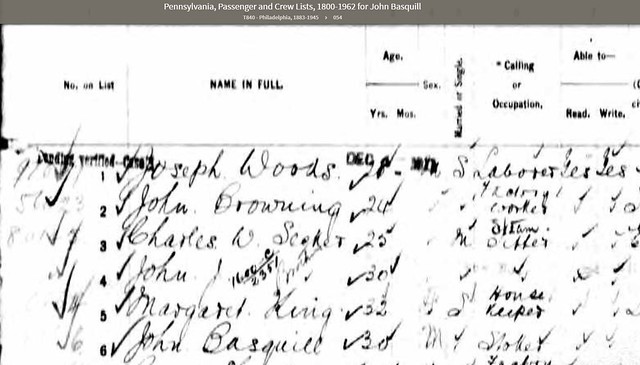
Manifest from Ancestry with Enhanced Images Turned On

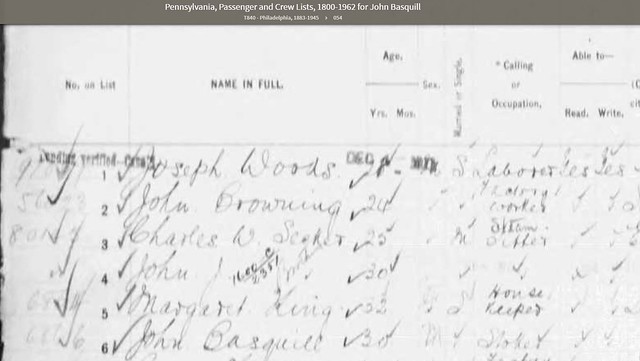
Manifest from Ancestry with Enhanced Images Turned Off
“Pennsylvania, Passenger and Crew Lists, 1800-1962,” database and images, Ancestry (http://www.ancestry.com/ : accessed 17 Sep 2017), manifest, Westernland, 29 Oct 1906, roll 54, image 316, line 6, John Basquill. Rec. Date: 22 Sep 2017.

I posted this in one of my genealogy groups, but I’m going to repost it here as a general warning, using John Basquill again.

This was prompted by an earlier discussion in one of my genealogy groups on images at Fold3 vs Ancestry, and how the Fold3 images were darker and, to some eyes, contained less information. I stated at the time that the opposite was true, and that I’d recommend turning off image enhancement at Ancestry, because you can lose valuable information if you don’t. Here’s an example.

One image with Ancestry’s image enhancement turned on (top), and one with it turned off (bottom). If you leave image enhancement turned on, you’d never know that there were contract ticket numbers in the left column of this manifest. You may not find those numbers important, but I’ve been able to use them to track an individual (and in the process fill in knowledge gaps) through multiple manifests where she failed to board the ship. Some of those manifest entries are crossed out, but the information in them helped me connect her to two different sisters living in the US and also to the townland she came from, which led me to her birth register entry and her parents’ names. All because I noted the contract ticket number and used it to collate several manifest entries.

The image on top may be prettier, but it is missing valuable information.