
I cannot for the life of me figure out which child the grandchildren belong to. I hate these sorts of loose ends, but since Martha was a second wife, and not an actual ancestor, I’m going to try to let it go.

I cannot for the life of me figure out which child the grandchildren belong to. I hate these sorts of loose ends, but since Martha was a second wife, and not an actual ancestor, I’m going to try to let it go.
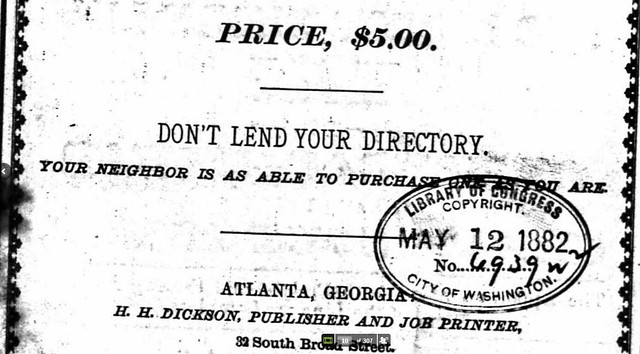
Don’t lend your directory. Your neighbor is as able to purchase one as you are.
The 1882 Atlanta city directoey cost $5. The inflation calculator I used says that’s $110 in 2015 dollars. I think I’d lend mine to my neighbors. It’s not like someone who couldn’t afford one would magically be able to purchase one, if their neighbor decided to be a stingy noshareasaurus. (Kinda like file sharing. No one has been able to prove that it hurts sales.)
In genealogy news, I got all the Atlanta city directory entries for James R. Thompson and Martha J. Edmonds entered into Excel and Legacy. That was a monumental task. I still have the rest of the Atlanta Thompsons to do, but it’s a start.
I found a thing! My mom said that when my great grandma Nell came over from Ireland, there was a fire on-board the ship while it was waiting to dock. I haven’t had any luck finding info about it, and I suspected it wasn’t a big enough deal to warrant news coverage. But I thought I’d trawl area newspapers for 2 Oct 1916 (she arrived on 1 Oct 1916, on the SS City of Philadelphia, and I doubted it would have been in any papers before the following day). I hit the jackpot.
“Liner Philadelphia Fought Fire at Sea,” The Sun, 2 Oct 1916, p. 1, col. 5; digital images, Library of Congress (http://www.loc.gov/ : accessed 4 Jun 2017), Chronicling America
Liner Philadelphia Fought Fire at Sea
American Steamship, 646 Passengers Oblivious of Peril, Docks Here.
Secret Known to Few
Blaze in Hold, Discovered off Grand Banks, Smothered by Steam.
A fire smouldering in her after hold unknown to all except a few discreet and favored persons among her 646 passengers, the American liner Philadelphia, from Liverpool, anchored at Quarantine yesterday morning. Included in her 110 cabin voyagers were several distinguished Americans and Britons. Capt. Candy did not let Quarantine officials know anything about the fire, and as there were no outward signs of it aboard the ship news men down the bay asked no question. Even after the steamship had docked little information was available from the passengers, and nearly all wanted to know from their questioners if there really had been a blaze at sea.
Miss Elsie Mackay, leading lady for Sir Beerbohm Tree, who was a passenger, when asked how she felt being on a burning ship, remarked in startled surprise:
“Fire? Why, nobody told me anything about a fire. That was what must have made it so hot in the saloon on Thursday evening.”
Sir Beerbohm Tree was also completely in the dark. This was due in part, he said, to his being a poor seaman, preferring the seclusion of his cabin most of the trip and not really caring whether or not disaster menaced the ship, which is the usual disposition of a poor sea-goer.
Captain Admits Blaze on Liner.
Capt. Candy admitted the existence of the fire after the ship had been made fast to her pier, but he did not regard it seriously. Exactly what damage it has done, or may be doing, will not be known until this morning, when a force of longshoremen will enter No. 7 hold, next to the last on the ship, and remove the charred cargo, consisting mostly of baled cloth, dress goods, and women’s hats.
Among the few who knew the captain’s secret was Dr. Joseph Byrne. An officer whom he knows well told him on Thursday afternoon, just after Chief Engineer Joyce had turned steam into the hold where the fire was, on condition that he keep the information from all other passengers. The doctor is a nerve specialist, and soon recovered his composure. A little later he studied the effect of the secret on the stewards, all of whom had been informed of the fire so they would be prepared for any emergency.
Stewards Pale and Silent.
The stewards looked paler than usual and were unusually quiet the rest of the trip. A steward delights in giving passengers exclusive information regarding almost anything, and absolute silence about the liner’s peril was a positive hardship. They were grave and occasionally talked in whispers. Meanwhile the passengers went about as if they hadn’t a care in all the world.
The natural reasons for keeping the travellers in the dark were the fear that if all hands knew about it the supersensitive and highstrung might suspect a plot to destroy the ship, or that there had been a secret submarine attack, or almost anything except the plain truth. Capt. Candy did not want to give his passengers any chance to misuse their fervent war imagination, and that is why he cautioned everybody to keep silent until the Philadelphia had put the last passenger ashore.
The saloon for several days was unusually hot. Some of the passengers remarked about it and asked the nearest steward why it was. But he adroitly attributed the warmth to the Gulf Stream, and that satisfied them. The heat, however, was due to the steam that was pouring through the perforated pipes of hold No. 7 and smothering the blaze.
Tells of Fire’s Discovery.
Capt. Candy said that early Thursday afternoon, when the Philadelphia was east of the Grand Banks, he learned that smoke was coming out of No. 7 hold. He went to Chief Engineer Joyce and steam was turned into the hold, the hatch of which is near the steerage dining room. Only a few passengers in the cabin knew about the fire and there was no confusion or excitement.
The captain said he had considerable anxiety for the well being of his 646 passengers and that is why he kept the knowledge of the fire from them. After the steam had been turned on an hour or so he went to the hatch and found the danger was apparently over. Smoke had ceased to pour out and steam was taking its place. He kept the steam on and it was still going when the ship docked and will continue to flow until longshoremen enter the hold this morning
Capt. Candy is inclined to believe that the fire was due to spontaneous combustion, perhaps in among the bales of cloth. Whether or not this is so will be ascertained this morning.
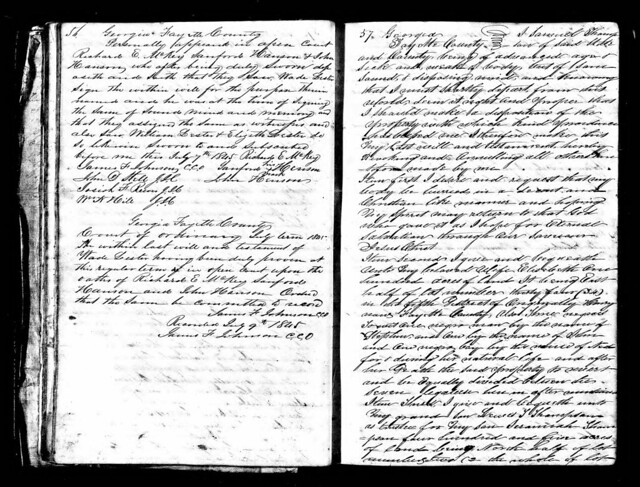
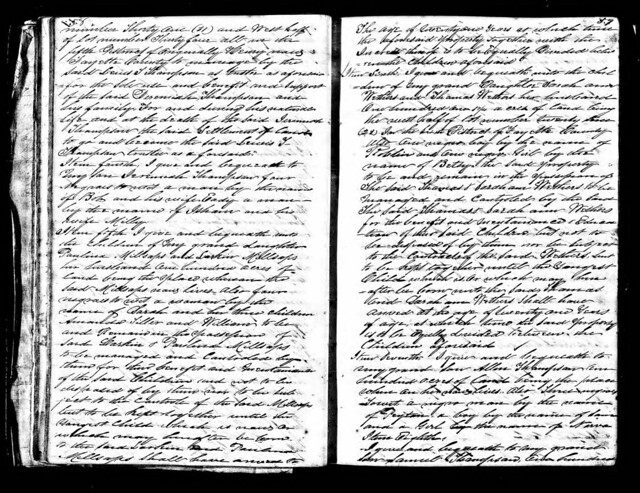
Samuel was my 6th great grandfather. At the time of the 1840 census–just five years before his death–he owned 21 slaves. I transcribed the document as well as I could, because unlike the census, it contains the names of the slaves he bequeathed to his survivors. Three slaves were left to his grandson, Samuel (my 4th great grandfather). At the time of the 1850 census, the grandson still had two slaves, a woman and young female child. By the 1860 census, he had no slaves.
This was obviously the period leading up to the Civil War. I wonder what prompted his divestment of slaves? Did he see the writing on the wall? Or did he have a conscientious epiphany?
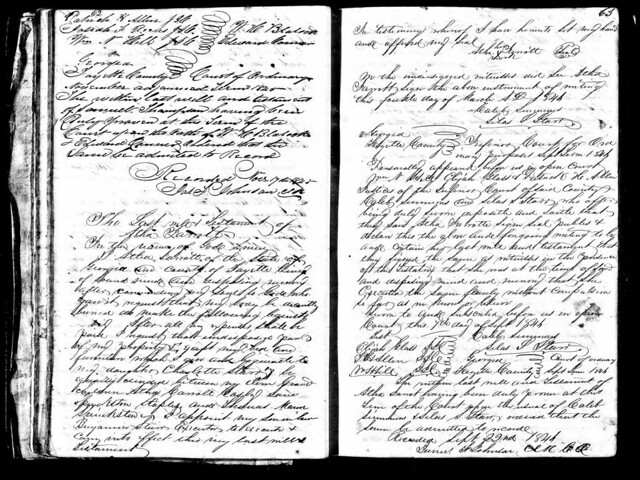
Georgia, Georgia, Wills and Probate Records, 1742-1992, Samuel Thompson will, signed 9 Oct 1945, proved 17 Nov 1845; citing Wills Book A 1823-1897, Fayette County, Georgia: Court of Ordinary, 1845, pages 57-62; digital images, Ancestry, Ancestry (https://www.ancestry.com/ : accessed 3 Jun 2017). Repository: Ancestry, 360 West 4800 North, Provo, Utah 84604
Georgia
Fayette County}
I Samuel Thompson son of said State and County being of advanced age & sick and weak of body, but of sane sound, & disposing mind, and knowing that I must shortly depart from this world, deem it right and proper that I should make a deposition of the property with which kind providence has blessed me. I therefore make this my last will and testament, hereby revoking and annulling all other heretofore made by me.
Item First. I desire and request that my body be buried in a decent and Christian like manner and hoping my spirit may return to that God who gave it as I hope for Eternal Salvation through our Saviour Jesus Christ.
Item Second I give and bequeath unto my beloved wife Elizabeth one hundred acres of land. It being East half of lot number thirty four (34) in the fifth District of originally Henry now Fayette County. Also, three negroes To wit one Negro man by the name of Stephen, and one by the name of John and one negro boy by the name of Ned for & during her natural life and after her Death the said property to revert and be Equally divided between the seven legateese here in after mentioned
Item Third, I give and bequeath unto my grand son Lewis T Thompson as trustee for my son Jeramiah Thompson four hundred and five acres of land being North half of lot number two (2) the whole of lot Thirty one (31) and West half of lot number Thirty four all in the fifth District of originally Henry now Fayette County to manage by the said Lewis T Thompson as trustee as aforesaid for the sole use and benefit and support of said Jeremiah Thompson and his family For and during his natural life and at the death of the said Jeramiah Thompson the said Settlement of lands to go and become the said Lewis T Thompson trustee as aforesaid.
Item fourth, I give and bequeath to my son Jeremiah Thompson four Negroes to wit a man by the name of Bob and his wife Eady a man by the name of Isham and his wife Milly.
Item fifth I give and bequeath unto the children of my grand daughter Paulina Millsaps and Larkin Millsaps her husband one hundred acres of land being the place whereon the said Millsaps now lives. Also four negroes to wit a woman by the name of Sarah and her three children Amanda Tiller and William to be and remain in the possession of said Larkin and Paulina Millsaps to be managed and controlled by them for their benefit and Meantainance of the said children and not to be disposed of by them nor to be subject to the control of the said Millsaps but to be kept together until his youngest child which is now or is or may hereafter be born to the said Larkin and Paulina Millsaps shall have arrived at the age of twenty one years at which time the aforesaid property together with the increase hereof is to be equally divided between the children aforesaid.
Item sixth. I give and bequeath unto the children of my grand daughter Sarah Ann Wethers and Thomas Wethers her husband one hundred one & 1/4 acres of land being the west half of lot number twenty three (23) in the Sixth District of Fayette County also one negro boy by the name of Robbin and one negro girl by the name Betty. The said property to be and remain in the possession of the said Thomas & Sarah Ann Wethers to be managed and contoled by the said Thomas & Sarah Ann Wethers for the benefit and mentainence & education their said children, but not to be disposed of by them nor be subject to the controls of the said Wethers, but to be left together until the youngest child which is or which may hereafter be born unto the said Thomas and Sarah Ann Wethers shall have arrived at the age of twenty one years of age at which time the said property is to be equally divided between the children aforesaid.
Item seventh. I give and bequeath to my grand son Allen Thompson one hundred acres of land being the place where on he now lives. Also three negroes to wit a negro man by the name of Peyton, a boy by the name of Sam and a Girl by the name of Nerva.
Item Eighth:
I give and bequeath to my grand son Samuel Thompson, one hundred acres of land being the place whereon he now lives. Also three negroes to wit a woman by the name of Silly & a Negro boy the name of Henry and a Girl by the name of Martha
Item ninth
I give and bequeath to my grand son James S Thompson the South half of lot of land number two (2) in the fourth District of originally [Henry?] now Fayette County also two negroes to wit a boy by the name of Joe and a Girl by the name of Phillis.
Item tenth. I give and bequeath to my grand son Lewis T Thompson one hundred and one and 1/4 acres of land being the East half of lot number twenty three (23) in the Sixth District of Fayette County also three negroes to wit a boy by the name of Robin son of Silly a boy by the name of Mishack and a boy by the name of Lewis
Item Eleventh, all the rest of my real estate wherever it may be, together with all the rest of my personal property consisting of horses, hogs cattle sheep etc all my farming utensials smiths tools of house hold and kitchen furniture to be sold by my executors hereinafter named, and after paying off all my just Debts out of the proceeds thereof the ballence to be equally divided between the Eight legatees hereinafter mentioned.
Item Twelfth
I constitute and appoint my grand son Lewis T Thompson and worthy friend Thomas Weathers my Executors of this my last will and Testament this ninth day of October in the year of Our Lord Eighteen hundred and forty five.
Samuel Thompson
Signed, Sealed and Delivered and Published, by Samuel Thompson in the presence of us the subscribers Who subscribed our names hereto in the presence of said testators and each other this October 9th 1845.
Thos Bynum
W. H. Blalock
Edward Conner
Georgia
Fayette County}
Inferior Court for Ordinary Purposes, November adjourned term 1845. Personally appeared before us in Open Court Elijah Glass Wm N Hill, Patrick H Allen & Iasiah F Reeves, Justices of this Inferior Court for said County, Wm H Blalock & Edward Conner, who after being Duly sworn deposeth and saith that they saw Samuel Thompson
Sign Seal Publish and declare this the above and foregoing writings to be and contain his last will and testament that they signed the same fully without compulsion so far as all know or believe. Sworn to and subscribed before us this 17th day of November Eighteen forty five
Patrick H Allen JIC
Iasiah F Reeves JIC
Wm N Hill JIC}
W H Blalock
Edward Conner
Georgia
Fayette County}
Court of Ordinary November adjourned term 1845 The written last will and testament of Samuel Thompson having been duly proven at this term of the court upon the oath of W H Blalock & Edward Conner ordered that the same be admited to record
Recorded Nov. 17th 1845
Jas. F Johnson clk

Member tree from Ancestry
Someone has misunderstood the nickname convention for replacing M with P. Martha = Mattie = Patty = Patsy. That’s understandable, but when they then fabricates an additional proper name out of a nickname, I have to wonder about the quality of their research. Do they make other incorrect inferences?
So for the record, her name was only and ever Martha Bishop. Patsy/Patsey was just a nickname for Martha.
ETA: Also, that death date. It is absolutely not correct, but I have no i idea where it’s coming from. A bunch of member trees for Martha include it. The best I can tell is that she died between the 1900 and 1910 censuses. It’s possible she remarried after her second husband, Samuel Thompson, died. I doubt it, though.
Martha is, by the way, the unnamed wife in Samuel Thompson’s will. Martha is not, however, her own spouse. This tree is a giant hot mess.
And check out this nonsense. There’s a Samuel C. Fernander living with Samuel and Parmelia Thompson, in the 1850 census. I tried to figure out what the connection is, because there probably is one. He isn’t listed as a hired hand, so maybe a relative?
I went to look at the world tree at FamilySearch. That’s always entertaining. I found him, and he appears to have a sister named Pamelia. Hm.

Maybe Parmelia was married before she married Samuel Thompson? Could Fernander be her maiden name? Unlikely, because she was only about 18 years old when she and Samuel married.
If you look at the Pamelia who is allegedly Samuel C. Fernander’s sister, you find that she’s got a bunch of kids who look remarkably like the children of Samuel Thompson and Parmelia Weathers. No spouse listed, but these are my people.

I could unlink her from this family and link her to Samuel Thompson, but sorting out the cascade of duplicates would make me cry. I’m not sure that mess can be undone. And of course there are no sources listed, so I have no idea where this crapfest came from. And I just looked at the past edits, and it looks like someone removed Samuel as the father. WTF?
ETA: If you look at the James Robert Thompson, son of Pamelia Fernander, you’ll see that his wife and children have absolutely nothing to do with my family. This should be my 3rd great grandfather, but he isn’t. Unless he had a second family on the side? Hm. Now that would be kind of entertaining.
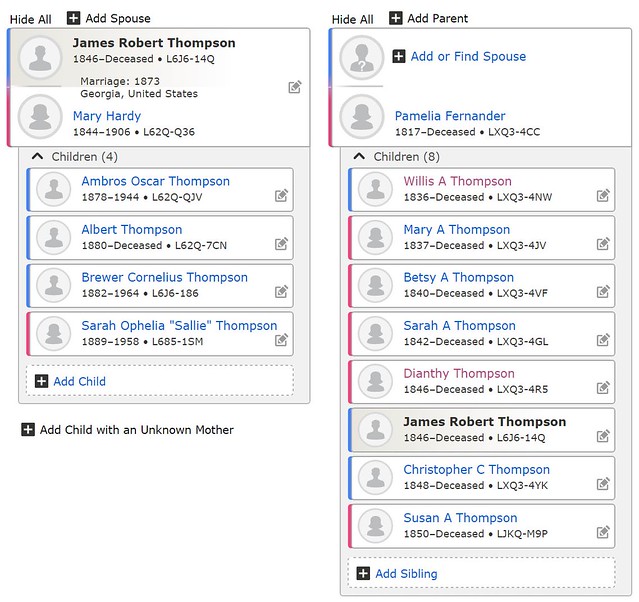
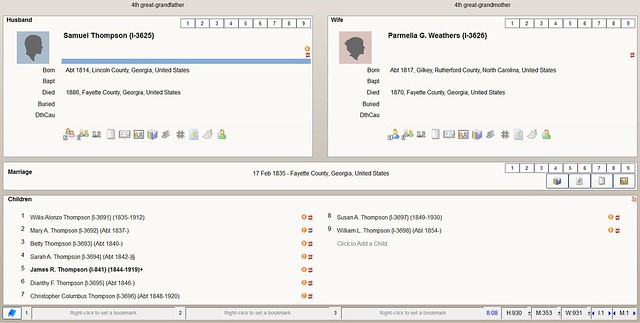
Samuel Thompson and Parmelia Weathers, Legacy Family Tree screenshot
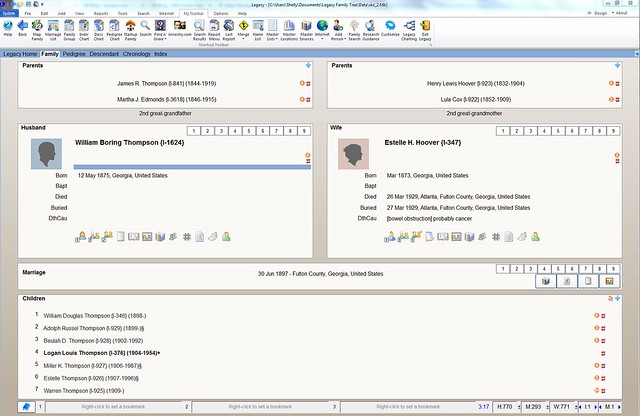
I’ve been working on this hot mess. Not to complain. There are far worse genealogical problems to have! I was finally able to break through a brick wall I thought I’d never crack. My maternal grandma’s parents were Logan Louis Thompson and Helen Gertrude Basquille. I knew who Louis’ parents were: William Boring Thompson and Estelle Hoover. However, the Thompson line went dead there, and the name is common enough that I didn’t have any hope of making any connections.
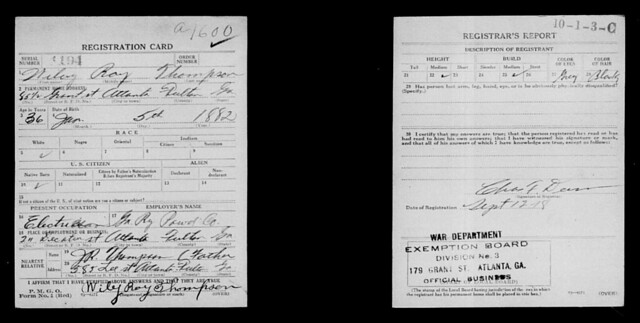
But then I started looking at William Thompson’s siblings, thinking I might be able to tackle it that way. He had a brother named Roy. Some more searching turned up that his first name was Wiley, and from there I was able to find his World War I draft registration card, where he names his father as his contact person: J. R. Thompson living at 585 Lee St, Atlanta.
“U.S., World War I Draft Registration Cards, 1917-1918,” database and images, Ancestry (www.ancestry.com/ : accessed 13 May 2017), Wiley Roy Thompson, serial number 1149, [no order number], War Department Exemption Board Division 3, Atlanta, Fulton County, Georgia; citing NARA microfilm publication M1509 (Washington D.C.: National Archives and Records Administration, n.d.); FHL microfilm 1556946.
It’s not much, but it was enough. I started scouring the Atlanta city directories. It took multiple passes; as I gathered each new clue, I went back and looked again, and again and again. I was able to piece together that J. R. is James R. He married Martha J. Edmonds in 1869, in Campbell County, Georgia. I’ve found a couple of tax records that I think match with him, for the 1870s, and then by 1880 the family moved to Atlanta, where James was working as a wood dealer. In 1882 he was listed as a grocer and butcher, then in 1885 a policeman. In 1886 he was a railroad watchman, then in 1891 he turns up as a farmer.
In 1894 things get weird. I can find his wife, Martha, listed in the Atlanta city directory. She’s living at the last known address for James, working as a dressmaker. In 1895 I find James at a separate address and Martha listed as his widow. That went on for a few years, with James turning up under the name John R. Thompson and living apart from Martha. Why the name change? And why tell everyone your husband is dead? There’s a story there that we will likely never know.
Then between 1901 and 1908, James disappears completely. In 1909 he’s lost the alias and is working as a peddler. He and Martha are living together again, too. They’re listed separately again in 1911. James is back to working as a wood dealer, and in 1912 he starts using the alias again. Martha dies in 1915, but James is listed, working as a wood dealer. There are a couple more blank years. The last directory he shows up in is 1918, where he’s listed as a retail grocer. He dies in 1919.
It’s a whole lot of tiny details, and if you don’t get your stepping stones in order, you won’t be able to cross the stream, so to speak. From what I can infer, he was decently well off at the start of his marriage. Something happened, though, and it looks like things kind of fell apart for him.
So we have James R. Thompson mostly sorted. There’s really not much information out there. However, he turns up again, in his father’s will. This is kind of awesome, because it tells me that I have the right pieces, and that I’ve put them together correctly. I an connect William Boring Thompson’s brother, Wiley Roy Thompson, to their father, James R. Thompson. And I can connect James R. Thompson to his father, Samuel Thompson.
Pet peeve: I wish Samuel had named his wife in his will. I can’t find any death records for Parmelia Weathers, but everything I could find said she died between 1870 and 1880. And that fit with my information. She was enumerated with Samuel in the 1870 census, but in the 1880 census, his wife was named Martha. And though you can’t take census information at face value, the 1880 census said Martha was born in Georgia. Parmelia was pretty consistent about giving her birth place as North Carolina. This is not a wrong name for the same person. Samuel had a second wife. And after some digging, I found their marriage record. It was the second marriage for her, as well. Her husband died, probably in the Civil War, given the timing. Martha and Samuel married in 1871. So even though Samuel didn’t name her in his will, the wife he mentions is Martha, not Parmelia.
The name on their marriage record is Martha Huddgings. I believe it’s actually Hudgens. That’s the surname of her first husband, though. Hopefully I’ll be able to find her maiden name, because I really want to give that back to her. There’s a really horrible entry in the world tree at FamilySearch for Samuel’s family, but it lists Martha. Twice. Apparently Samuel and Martha are Samuel’s alternate parents. There’s another entry for Martha, with her first husband. It’s also a giant rat’s nest, but it gives Bishop as her maiden name, which might be useful. This tree lists a totally unrelated second husband. I have no idea who he is or why anyone though he belonged there. But if you look
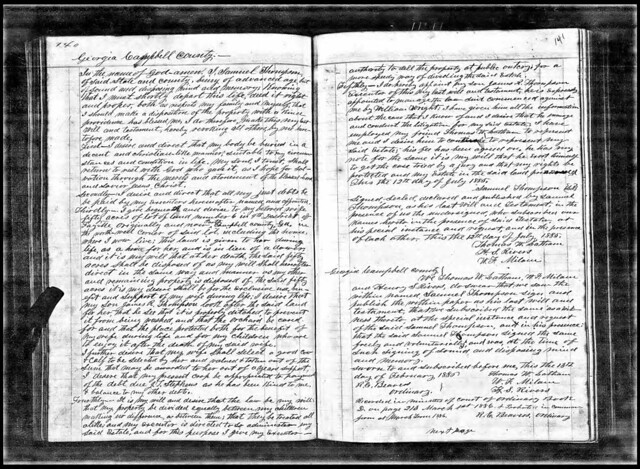
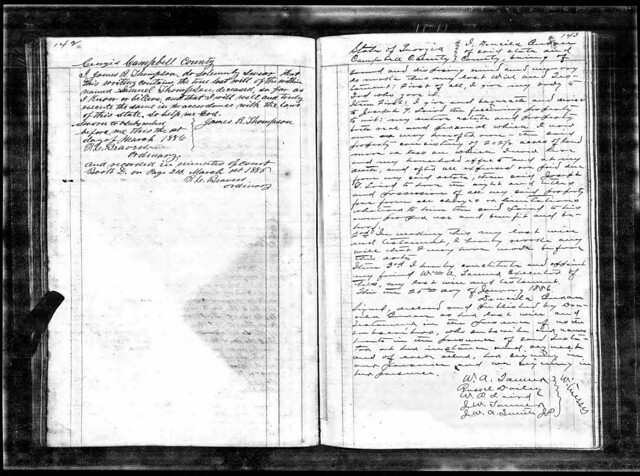
Georgia, Wills and Probate Records, 1742-1992, Will of Samuel Thompson probated 12 Jul 1885, Fulton County, Georgia; digital images, Ancestry, Ancestry (www.ancestry.com/ : accessed 26 May 2017)
Georgia Campbell County: —
In the name of God-amen. I, Samuel Thompson, of said state and county, being of advanced age, but of sound and disposing mind and memory; Knowing that I must shortly depart this life, deed it right and proper, both as respects my family and myself, that I should make a disposition of the property with a kind providence has blessed me, I do therefore, make this my last will and testament, hereby revoking all others, by me heretofore made.
First — I desire and direct that my body be buried in a decent and Christian-like manner, suitable to my circumstances and condition in life. My soul, I trust, shall return to rest with God who gave it, as I hope for salvation through the merits and atonement of the blessed Lord and Savior Jesus Christ.
Secondly — I desire and direct that all my just debts be paid by my Executors hereinafter named and appointed.
Thirdly — I give bequeath and devise to my beloved wife fifty acres of lot of land number 6 in 9th District of Fayette originally and now partly Campbell County, Ga. in the north-west corner of said lot, including the house where I now live; this land is given to her during life, as a home for her, and is in lieu of a dower, and it is my will that at her death, the said fifty acres shall be disposed of as my will shale hereafter direct in the same way and manner as my other and remaining property is disposed of, the said fifty acres it is my desire shall be for the exclusive use benefit and support of my wife during life; I desire that my son James R. Thompson look after the said land for her, that he see that it is properly ditched, to prevent it from being washed, and that the orchard be cared for and that the place protected both for the benefit of my wife during life and for my children who are to enjoy it after the death of my said wife. I further desire that my wife shall select a good cow & calf to be selected by her and valued & taken out of the sum that may be awarded to her out of a years support, I desire that my present crop be appropreated to payment of the debt due J. T. Stephens as he has been kind to me, & balance to my other debts.
Fourthly — It is my will and desire that the law be my will that my property be divided equally between my children making no difference, as between them; that they be treated all alike, and my executor is directed to so administer my said estate, and for this purpose I give my executor authority to sell the property at public outcry; for a more speedy way of dividing the said estate.
Fifthly — I do hereby appoint my son James R. Thompson Executor of this my last will and testament, he is expressly appointed to manage the law suit commenced against me by William Wright; I have given him all the information about the case that I know of and I desire that he manage and conduct the litigation for my said estate; I have employed my friend Thomas W. Latham to represent me and I desire him to continue to represent my said estate; his fee has been agreed on, he has my note for the same it is my will that he exert himself to get the case tried by a jury and that my rights be protected and my estate in the said land [preserved?].
This the 12 day of July 1885.
Samuel Thompson
Signed, sealed, declared and published by Samuel Thompson, as his last will and testament, in the presence of us the undersigned, who subscribed our names hereto in the presence of said testator, at his special instance and request, and in the presence of each other, this 12th day of July, 1885.
Thomas W. Latham
H. S. Rivers
W. F. Milam
Georgia Campbell County }
We Thomas W. Latham, W. F. Milam and Henry S. Rivers, do swear that we saw the within named Samuel Thompson sign and publish the within paper as his last will and testament, that we subscribed the same as a witness thereto, at the special instance and request of the said Samuel Thompson, and in his presence; that the said Samuel Thompson, signed the same freely and voluntarially, and was, at the time of such signing, of sound and disposing mind and memory.
Sworn to and subscribed before me, this the 13th day of February, 1886
Thomas W. Latham
W. F. Milam
H. S. Rivers
R. C. Beavers
Ordinary.
Recorded in the minutes of court of ordinary book D of page 213 March 1st 1886 & probated in common form at March Term 1886.
R. C. Beavers, Ordinary
next page
Georgia Campbell County
I, James R. Thompson, do solemnly swear that this writing contains the true last will of the within named Samuel Thompson, deceased, so far as I know or believe, and that I will well and truly execute the same in the accordance with the laws of this state, so help me God.
James R. Thompson
Sworn to & subscribed before me this 1st day of March 1886
R. C. Beavers
Ordinary.
Here’s another lesson in why it’s important to research siblings, not just direct line ancestors. I had hit a brick wall on my Thompson line, after realizing that the link between my great great grandfather, William Thompson, and who I thought were his parents was bad.
This is what happens when you rely on other people’s research. Everything seemed reasonable, but when I looked closer, it was a flaming hot mess. So I removed a whole bunch of folks from my working tree and started over again. Thing is, there was very little to go on. Thompson is such a common name, and the only concrete info I had was that William was born in Atlanta and had a brother named Roy.
So after exhausting every avenue with William, I started looking at Roy. Lo and behold, I hit pay dirt. I had a scribbled note from either my mom or grandma saying that Roy had lived across the street from Beulah. Doesn’t sound like much, but it was. I was able to figure out that the W. Roy Thompson in the 1930 census was, indeed, “my” Roy, based on the street address.
There was another mom or grandma note that Roy had married a woman named Avis, and there she was with him, in the 1930 census. They were living at 1411 Beatie Avenue. I found my great great grandmother Estelle (Roy’s sister in law) living at 1412 Beatie Avenue in the 1910 census. Beulah was Estelle’s daughter and Roy’s niece. So there we have Roy living across the street from Beulah, albeit the time span was a bit long between the two events.
From there, I was able to piece together that Roy’s first name was Wiley, and I found his WWI draft card, where he lists his father as J. R. Thompson, living at 585 Lee Street.
That was enough of a clue to get me to the next generation back. James R. Thompson married Martha J. Edmonds. James fought in the Civil War (on the wrong side). His right arm was shot off below the shoulder at Sharpsburg, in 1862. He survived, so there’s a pretty large military pension file for him. For reasons unknown, he and Martha lived separately. I found her and Roy in the 1900 and 1910 censuses, and she’s listed as married, but no sign of James. I haven’t found him (yet) in any of the censuses, but I haven’t looked very hard, either. That’s something for another day.
I did some quick and dirty scanning of other people’s trees (always entertaining, but dangerous if you take it too seriously). It looks like that line goes back to Adam and Eve. I’ll stop tracing it when the real documentation runs out. Some of those trees I looked at had 10-12 “sources,” but when you look closely, they’re all “Ancestry member tree” or “Millennium File.” Run away from those. They are not fit to crib clues from. I promise, if you try, it will end in tears.
Oh, and everyone and his brother seems to think that William Thompson’s middle name started with a D. It was Boring. No idea where the D is coming from. He spells it out nicely on his WWI draft card, where he is inexplicably working as a cook in Washington DC. But the contact person he lists is Estelle Hoover at the same address I have her at, with my great grandfather Louis living with her, so I know it’s all legit. Just one of those strange family history mysteries.
And because I love a visual aid, here’s the new family group screen from Legacy.
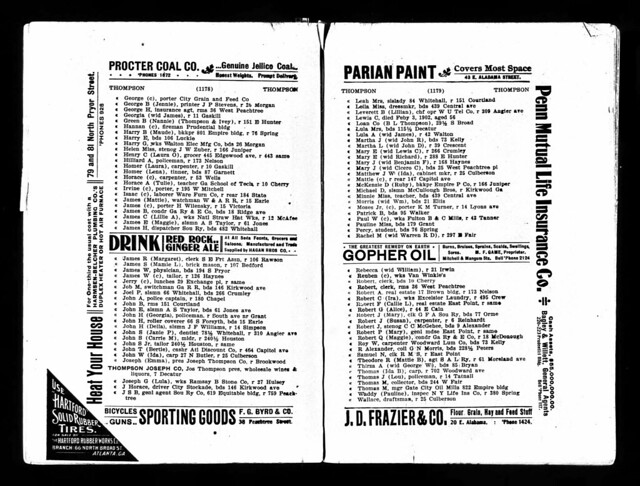
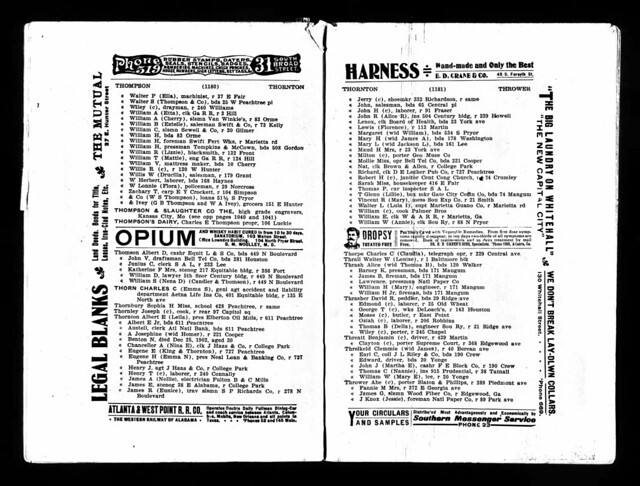
Now, for part two: City Directories. I love them so much it’s not even funny. I just found Martha J. Thompson, the newly discovered mother of William Boring Thompson and Wiley Roy Thompson, in the 1903 Atlanta city directory. She was living with William and his wife, Estelle, at 73 Kelly Street. Roy is also living with them.
There’s the final piece of evidence I needed to feel 100% confident that I finally had the right parents.
Ancestry, “U.S. City Directories, 1822-1995,” database and images, Ancestry (www.ancestry.com/ : accessed 14 May 2017); citing Atlanta City Directory 1903, volume XXVII, [Atlanta, Georgia]: Foote and Davies Company and Joseph W. Hill, 1903, pages 1179-1180.
This, by the way, was two years after William Thompson and his brother in law, Adolph Taylor Hoover, were recorded in the Atlanta city directory as co-owners of a butcher shop (cleverly named W. B. Thompson and A. T. Hoover Meats). Apparently that business crashed in burned. Or maybe it was sold to a larger company, like Hormel.
[ETA: You may notice that Martha J. Thompson is listed as the widow of John R. in the 1903 directory. I have no explanation why, at this point. I know they were estranged, but she describes herself as married in the 1900 and 1910 censuses. Nor do I know why his name is listed as John in the directory, when everywhere else he’s James. For now, the address is the most important clue. The city directories are full of weird mistakes. As far as I can tell, James R. Thompson died in 1919, a year after he was listed as a contact person on his son, Roy’s, World War I draft card.]
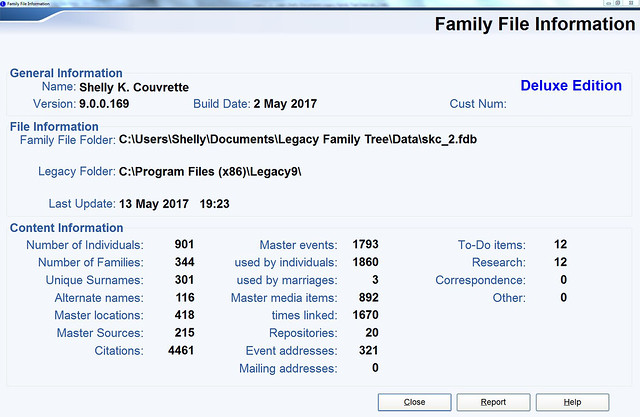
I don’t think I’ll ever have one of those family trees that goes back to Adam and Eve. That seems to be the goal of some folks, but I’d rather do solid research. At this point, I have almost 5 sources for each person, on average. That’s the number that matters to me, not the small number of individuals.
There is a lot of great information in the old city directories, but you cannot rely on the OCR used to generate the index entries. You really need to search each and every year for your location manually, if you want to find everything. Why? Doing so will help you pinpoint marriages, deaths (maybe), and migration dates.
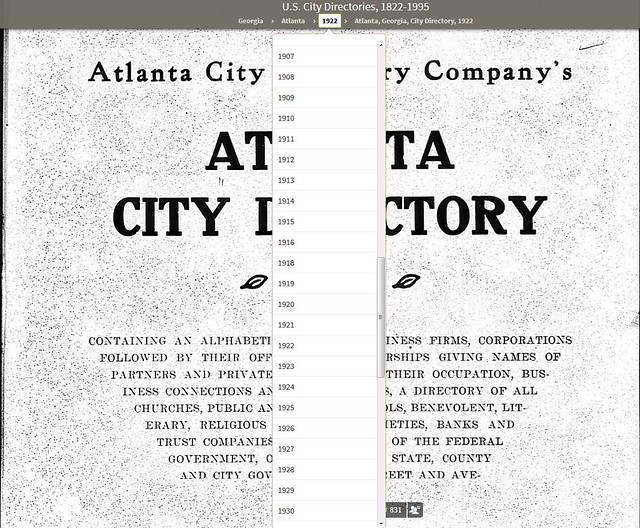
To do so, at Ancestry, you use the drop-down menu to navigate between years. Occasionally there will also be a drop-down menu for various directory titles covering the area, as well. Searching the index at Ancestry for my great grandmother, I only found a handful of entries when in fact, there was a nearly full run of entries spanning 1920 to 1950.
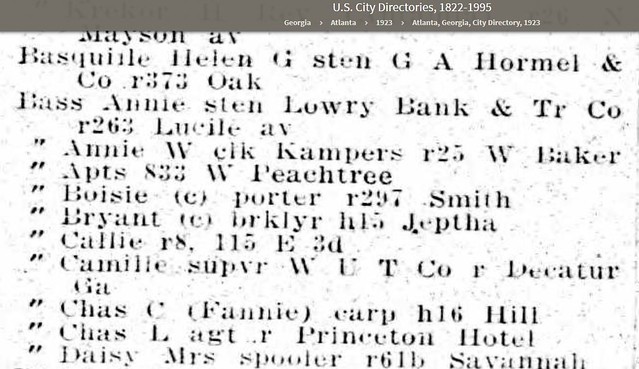
Ancestry, “U.S. City Directories, 1822-1995,” database and images, Ancestry (www.ancestry.com/ : accessed 12 May 2017); Helen Basquille page 231; citing Atlanta City Directory, volume XLVI, Atlanta, Georgia: Atlanta City Directory Company, 1923.
This entry was not picked up by OCR, probably because the scan is kind of grim. You can see that she was a stenographer at Hormel. She was about 28 years old in 1923, and she worked for the company until she retired.
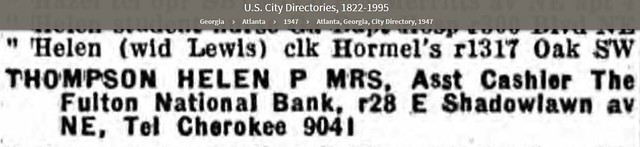
Atlanta City Directory 1947
My great grandfather didn’t die until 1954, so I don’t know why my great grandmother was listed as his widow in 1947. They were divorced in the early 1930s, so maybe she figured he was dead to her?
1930 United States Census
If you look at the far right column, you’ll see that my great grandmother was described as a widow. I thought it was an enumeration mistake or a misinformed informant, until I saw the same thing in the 1947 Atlanta city directory. I wish I knew what was going on.
The last year Helen was listed in the Atlanta city directory was 1950. I found her in the Austin, Minnesota, directory in 1953. I knew she had moved to Minnesota around that time, but this helps pinpoint the date. And yes, I can and will ask my mom when Helen moved, but it’s nice to have tangible evidence to back up the claim. Early 1950s is about right, as that’s when my grandma started having kids. Grandma was an only child, and I’m sure her mom wanted to be closer, after the grandbabies started arriving.
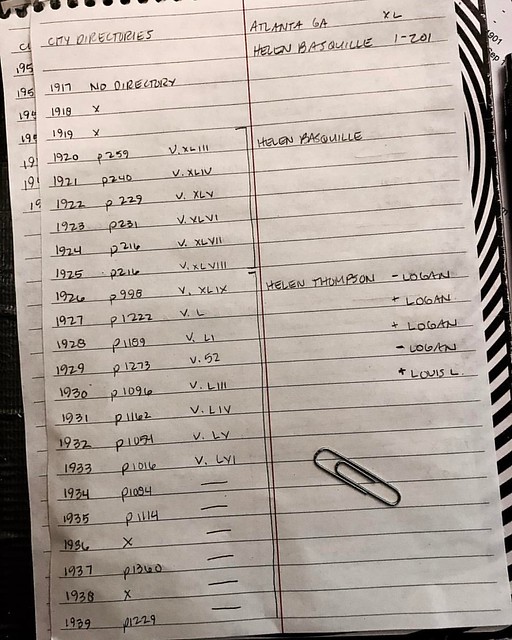
I don’t print out index entries for the city directories. Instead, I make a list on paper. It’s tedious, yes, but it helps keep you from missing entries. It also makes it easier for patterns to pop out. So you can see that my great grandfather, Logan Louis Thompson, only lived with my great grandmother for a short period of time. They were married in 1924, and he was gone by 1930.



 red paper boat