Genealogy, Pets, Photography

Sasser with Tiny Teefs

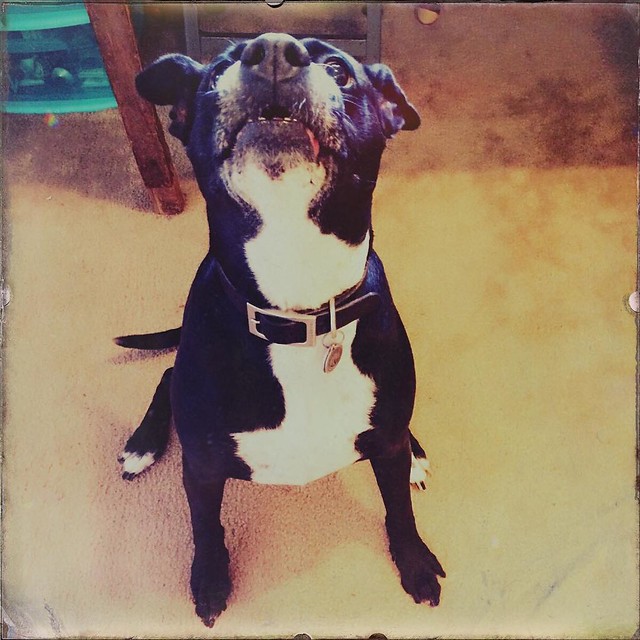
Sasser with Tiny Teefs #dogs #pitbulls #pitbullterriers #pitbullcomplaints #tinyteefs

Frances hurt her left knee a few days ago. She’s been on bed rest, which is not her favorite thing. Today she sat fairly straight for the first time (no side-saddle, though her knees are akimbo), so I think she’s finally feeling better. Her sasser is functioning at 100%.

In other news, I’m finally (FINALLY!) finished trawling the 1939 Register for Basquills (and all the various permutations). It ended up taking longer than I thought it would, but it filled in a lot of gaps.

Genealogy

Arthur Herbert Baskwill

Things I do not understand. I have a William Baskwill born in Ireland about 1844, who was in England by the 1871 census and married to someone named Elizabeth, who was born in Staffordshire.

Okaythen. I’ve found a son of theirs, Arthur Herbert Baskwill (or Herbert Arthur, occasionally), in the 1939 Register and am trying to figure out who his apparent wife, Barbara, was. Can’t find their marriage, which would lead to her last name. Hmf.

But when searching all records at Ancestry, I found a tree with Arthur Herbert in it. And his parents, William Baskwill and Elizabeth Brown. So maybe his mother has a surname, at least. Okay, what sources is this person citing? They claim that William and Elizabeth were married in 1868 in Castlebar. Um, no, that is really unlikely if she was born in England.

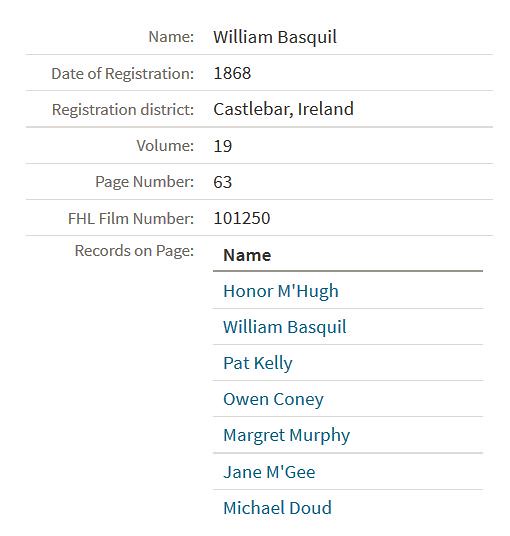
William Basquil
Ireland Civil Registration Marriages Index, 1845-1958

So I look closely at the source this person is citing. It’s from the Irish Civil Registration Index. The only information you will get there are names and the date the marriage was registered. It will not tell you who those people are attached to, or even which people on the list married each other. Sometimes this is still a helpful resource, but you have to use it carefully. I see no one with the last name of Brown, nor do I see any Elizabeths. Why on God’s green earth did this person think this was a marriage for William and Elizabeth in London, England?

I spent an hour on that nonsense, chasing it around and around. I even pulled up the parish marriage register for 1867-1868 for Castlebar, just for the sake of thoroughness. Nope. Nothing there, either.

This was not a total waste of time, actually. Who did the William on that list marry? The easiest way to narrow it down is to look at the next census, to see who he’s living with. That won’t work here, though, because there isn’t an extant Irish census until 1901. Too much time has passed between the events for the census to be helpful. For now he’ll go in the “To Think About Later” pile. (And it’s possible that, if I go look in my paper files, I have more information on him that I just haven’t entered into the database. I’m too lazy to do that right this minute, though.)

Genealogy

Corrections at Findmypast

Irish Catholic Parish Register
“[July 1st 1860]
Shraugheen
John of John Baskquill & Biddy Kelly
S.S. Wm. Baskquil & Mary Kelly”

Microfilm 04210 / 05 | Page 32
Aughagower; County of Mayo; Archdiocese of Tuam. Baptisms, May 1860 to Sep. 1860

Irish Catholic Parish Register Index at Findmypast
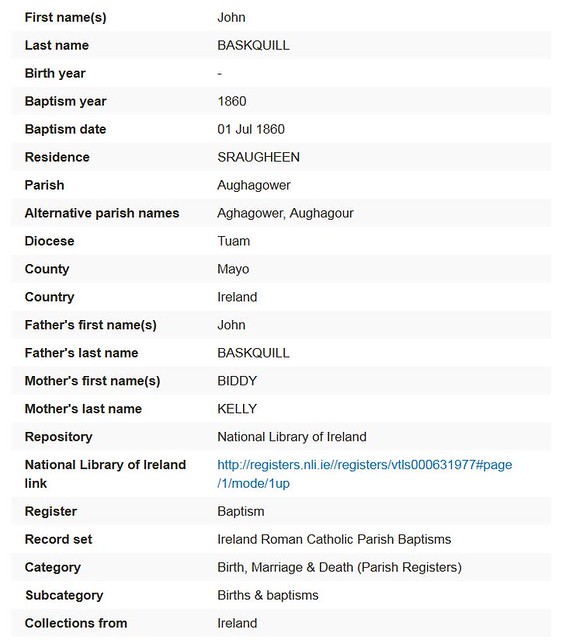
Index page from Findmypast for the above image

As I’ve searched through the Catholic Parish register indexes at Findmypast, I’ve been submitting corrections. I do the same thing at Ancestry. Ancestry can take months to update their indexes, if they do at all. I had no idea what time-frame to expect from Findmypast, but I was shocked to see that corrections I filed just a few days ago have already gone live. You can see them in the above screenshot.

The last name in the index was spelled Bashguill. Somebody consistently had trouble with the “q” in the name, transcribing it as a “g.” Mistaking the “k” for an “h” was maybe a little more forgivable? I have the advantage of having worked with this name for years, so I’ve seen it all. Some day I’ll compile a list of all the different spellings I’ve seen.[1]

As well, John’s mother’s name was transcribed as Bridgt Kely. It’s clearly Biddy Kelly. It may not make a big difference in the long run, as Bridgt and Biddy are an abbreviation and variant of Bridget. At Findmypast, they do a good job of cross-referencing, if you check the name variants box. People would probably find the mis-transcribed record, if they search carefully, but better to make it right, right?

I am also adding townlands, where they’re recorded in the original record. I figure I may as well, since I’ve got the edit screen open and the image right in front of me. John was born in Shraugheen, which is an old variant spelling of Sraheen. The townlands are indispensable in determining who’s who. (Do you have any idea how many John Basquills there are?!)

You can see the fields I edited, because they’re in all caps. Kind of fabulous, I think. And unlike corrections filed at Ancestry, where I sometimes feel like they disappear into the void, this was timely positive reinforcement from Findmypast.

____________________________________
1. I laugh when people in my genealogy groups talk about how they diligently add every spelling variant they encounter as an AKA. I’d have 30 AKAs for each person, if I did that, and my name index would be ridiculous. I record the name variants in the source citation, where I transcribe the record fully. That is going to have to be good enough.

It must be nice to only have one or two common name variants.

Genealogy

Research Strategies

I have spent the evening looking at lateral parts of my tree. Specifically the family of John Bourke and Mary Jennings. Their daughter, Bridget, was Walter Basquill’s second wife and my great-great grandmother.

Some folks just follow their tree up and ignore the sideways growth. I think that’s a huge mistake. Looking at siblings and even cousins gives important context and can help solve mysteries. Like the mystery I like to call the Myles Basquill Problem.

I can find no trace of any such person. My grandma said that her mother talked about a sibling named Myles, who had drowned in a pond. And that is literally all I know. I don’t know when he was born or how old he was when he died. I don’t even where he fell in the order of children or which of Walter’s wives was his mother.

I have two clues, though. Looking at Bridget Bourke’s family, she had a brother named Myles, as well as uncles named Myles on both her mother’s and father’s sides. It’s possible that Walter’s first wife, Mary McHugh, also had relatives named Myles, but as yet I have no way of tracking that because I don’t know who her parents were. I think, though, that it would make a certain amount of sense if Myles were my great grandma Nell’s younger brother. That sort of thing would haunt you for life, right? I get the impression that she didn’t talk much about her life in Ireland, but she did mention Myles. And she did so in a way that made an impression on my grandma.

I wouldn’t have put those two clues into the same context, if I hadn’t been researching laterally, looking at my great-great grandmother’s family.

But that all leads me to a new problem.

I can find baptismal records for a bunch of Bridget’s siblings, but not one for her. I had a baptismal date for her, but the source for that was Pat Deese’s transcripts. Those are all hosted on Rootsweb, which is down right now and will be for at least another week. Normally that wouldn’t be a big deal, but the baptismal date I have for Bridget is in conflict with the baptism of one of her siblings. Both dates cannot be true. Something fishy is going on, but I can’t figure out what.

Genealogy

Walter Basquill and Mary McHugh

Castlebar Marriage Register
Castlebar | Microfilm 04214 / 03 page 79

“[20 Feb 1871] Walter Basquill to Mary M Hugh
P[resent] Michael Basquill & Mary Cannon J.R.”

I was telling my mom about some of the information packed into these Irish Catholic parish registers. It doesn’t look like much, but you have the date, the who, the witnesses (including Walter’s father, Michael), the initials of the priest who married them, and over in the right margin the amount they paid to be married.

And then every so often you will find a notation that everything was settled up to date, meaning that all fees had been collected. So these registers functioned as part of the parish bookkeeping system, as well as a record of who was baptized and married.

If you go through them page by page, instead of relying on the indexes, you will also find that each priest would make entries for his own records, then settle up, and then the next priest would have his turn with the register to enter his information. The handwriting varies section by section, as well as (sometimes) the geographical area covered. So the J. R. who married Walter and Mary will likely be identifiable, if I look more closely at this volume of the marriage register.

I mention all of this because it seems like a goldmine to me, after the dearth of records available for pre-civil registration Ireland (1864). Yet someone in one of my genealogy groups took a look at the registers and declared that they were useless, because they’re just a bunch of names and dates. Wellokaythen.

(This is Walter’s marriage to his first wife, by the way. I can’t find an entry in the parish registers for his second marriage, the one to my great-great grandmother Bridget Bourke. That was after civil registration began, though, so there should be a marriage certificate available.)

Genealogy

Catholic Parish Registers at Findmypast

Findmypast announced that they, too, have indexed the Irish Catholic parish registers (Ancestry announced their index was forthcoming, and indeed it is now online).  Findmypast is offering free access to their Irish Catholic parish records index FREE this week.  This is kind of a big deal.  If you have Irish ancestors, do go take a look at Findmypast.

Some thoughts, after a quick trawl of both Findmypast and Ancestry.  Findmypast provides a hot link directly to the volume at National Library of Ireland (where I’ve been manually searching the very same images).  So they are using the same image set.  This also means that these images, after you have the correct index information, will be free to access at NLI even after the free week at FMP is over.  They just won’t be indexed at NLI.

Second, Ancestry’s scans are different.  I’m not surprised.  At first glance they look lesser quality than the scans at FMP/NLI, but I think it will be worth looking at them for pages that are difficult to read.  It’s possible that the higher contrast images at Ancestry will make some things more legible.

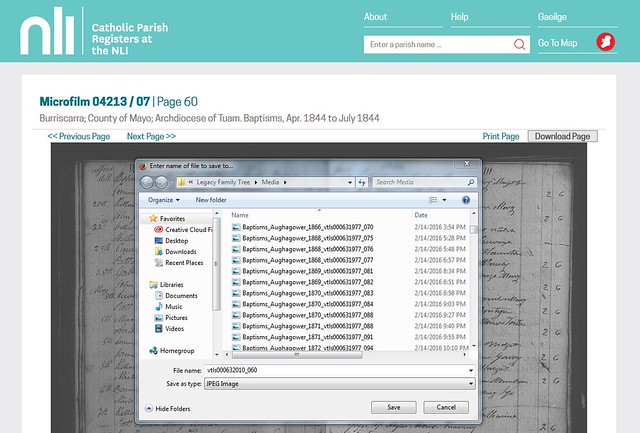
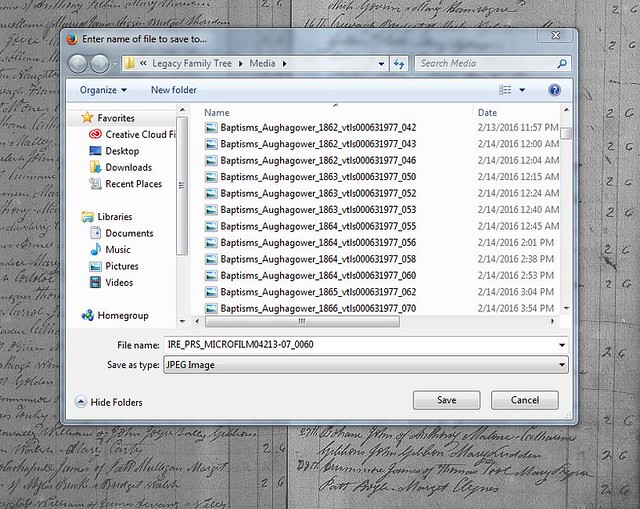
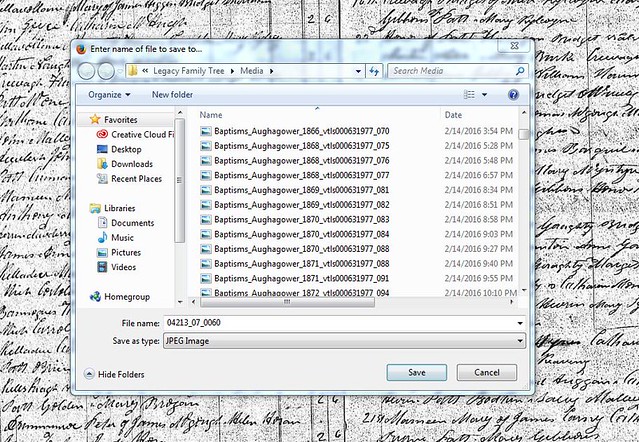
I was kind of bummed, though, that neither Ancestry nor FMP seemed to provide the volume or page number for the image. That’s important information. But then I did a test download at each site and saw that it is preserved. It’s just not provided in the index.

So, where is the volume and page number? It’s in the file name, which you will see when you download the image.

National Library of Ireland
National Library of Ireland, Catholic Parish Registers

Find My Past
Findmypast

Ancestry
Ancestry

These are all three showing the same page in the same volume. You can see the full film number, volume number, and page number on the first example from National Library of Ireland. The second is from Findmypast. There you can see that the file name contains the same information. First is the microfilm set, then the volume, then the page number.

The third example is from Ancestry. Again, the metadata is retained in the file name. Also note that the scan, though of the same page as in the other two examples, is of much lower quality.

Genealogy

A Receipt to Make Barm

A Receipt to Make Barm

A Receipt to Make Barm

Boil one pound of good [flour], a quarter of
a pound of Brown Sugar & a little Salt
in two Gallons of water for an hour
when milk warm Bottle it & cork
it clos it will be fit for use in 24 hours

after breakfast take half a teaspoonful of
grated ginger in a wine glassful c/ water

From: Microfilm 04225 / 02 | Page 7
Swineford; County of Mayo; Diocese of Achonry. Baptisms

Barm is the frothy crud that floats to the top when you make wine or beer. It can be used as a leavening agent for baked goods.

I don’t know if the last part is related to the first in some way. I doubt it, though. I think it’s just run together: the recipe for barm, then directions on the making of a preparation to be taken after eating breakfast.

What really interests me, though, is that this was written at the beginning of one of the Irish Catholic parish registers I’ve been searching. This particular one contains baptisms in Swineford, County Mayo. I cropped the page so you can see the date: 1817. The first part of the volume also includes a recipe for a medicinal concoction containing green capers, then several pages with bookkeeping figures and names of parish workers, their work terms, and what they are to be paid, down to the cost of nails for a worker’s shoes.

Clearly the priest used this book as a ledger and personal diary, before re-purposing it as a baptismal register.

Genealogy

Patt Tenpenny

Marriage Register
Microfilm 04222 / 03 | Page 77
Multiple Parishes; Multiple Counties; Archdiocese of Tuam. Marriages, June 1822 to Nov. 1823

“Sept 7th [1822] Patt Tenpenny to Sealia McDonaugh”

This has nothing whatsoever to do with my own family, but I love the name.

It also gave me a clue to an unrelated mystery. There is a classified ad in one of the databases on Ancestry that has always perplexed me.  

Missing
Searching for Missing Friends: Irish Immigrant Advertisements Placed in “The Boston Pilot,” 11 Jan 1868

Who is Seatia? That is not a name that’s found in the area of Ireland these folks come from. However, Celia is, and 19th century spelling being what it is, the name often shows up as Sealia. I think that’s the name in the ad. Either there’s an OCR failure or there was a mistake made when the ad was originally placed.

Not that this helps me figure out who these folks are. I think the Catherine in the ad must be Catherine Moore, who married Patrick Basquill in 1831. They emigrated to England, and he died there in 1860. Afterward Catherine came to the US and settled in Cincinnati. I know she was living on Water Street at one point, so this ad had to have been placed by her.

I’m not sure who Sealia would be, though. It would have been a nickname, but for which girl? There was a daughter named Bridget. Delia seems to be a common nickname for Bridgets in this family, and it’s similar to Sealia. But as far as I can tell Bridget never left Ireland.

There is a son named John, but again, as far as I can tell he stayed behind in Ireland. At least, he and Bridget were still there as of the 1901 census. If either of them came to the US, they later returned to Ireland.

James is the only one of the three that fits. He was in Cincinnati by 1874, but I don’t know where he was in 1868. The only problem here is that he would have been about 8 years old in 1858, the point in time when Catherine lost track of the children.

Lastly, she describes herself as their step-mother. I don’t know of a previous marriage for Patrick. That doesn’t mean there wasn’t one, of course.

It’s just all very odd to have one piece of the puzzle clearly pointing to Catherine Moore being the woman who placed the ad (the address), but none of the other pieces quite fit.

But at least now I can be fairly certain–thanks to the newly Mrs. Tenpenny–that the Seatia in the ad is really Sealia.
Genealogy

A Child Scalded to Death

John Basquill

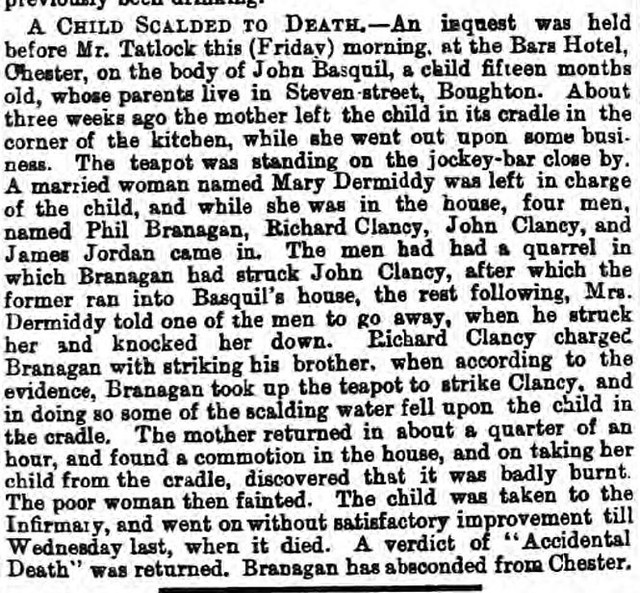
“A CHILD SCALDED TO DEATH.– An inquest was held before Mr. Tatlock this (Friday) morning, at the Bars Hotel, Chester, on the body of John Basquil, a child fifteen months old, whose parents live in Steven street, Boughton. About three weeks ago the mother left the child in its cradle in the corner of the kitchen, while she went out upon some business. The teapot was standing on the jockey-bar close by. A married woman named Mary Dermiddy was left in charge of the child, and while she was in the house, four men, named Phil Branagan, Richard Clancy, John Clancy, and James Jordan came in. The men had had a quarrel in which Branagan had struck John Clancy, after which the former ran into the Basquil’s house, the rest following. Mrs. Dermiddy told the men to go away, when he struck her and knocked her down. Richard Clancy charged Branagan with striking his brother, when according to the evidence, Branagan took up the teapot to strike Clancy, and in doing so some of the scalding water fell upon the child in its cradle. The mother returned in about a quarter of an hour, and found a commotion in the house, and on taking her child from the cradle, discovered that it was badly burnt. The poor woman then fainted. The child was taken to the Infirmary, and went on without satisfactory improvement till Wednesday last, when it died. A verdict of “Accidental Death” was returned. Branagan has absconded from Chester.”

From: Cheshire Observer 1865 Sep 16 page 5 column 2

John Basquill was the son of Mark Basquill and Catherine Lalley. He was the third child of theirs to die as a baby.

It can be easy to forget, when you’re looking at mountains of birth, marriage, and death records, that those bare facts belong to real people with real stories to tell. I’ve known for years that Mark Basquill and Catherine Lalley had lost their son, John, at a young age. I had no idea how or why.

Another son, Mark, died at age 11, and a daughter, Catherine, at 18. That’s five children who died young, most as babies. Of the two oldest children, one daughter named Mary emigrated to Massachusetts but soon of enterocolitis and exhaustion. She was just 26. Another daughter, Margaret, was born in 1859 and was recorded in the 1871 England census, but I can’t find any trace of her after that point. It’s possible she emigrated to the United States or married, before the 1881 census.

Out of seven children, I can find evidence for only one of them reaching adulthood.