Art, Journals

Stone Paper

IMG_6974

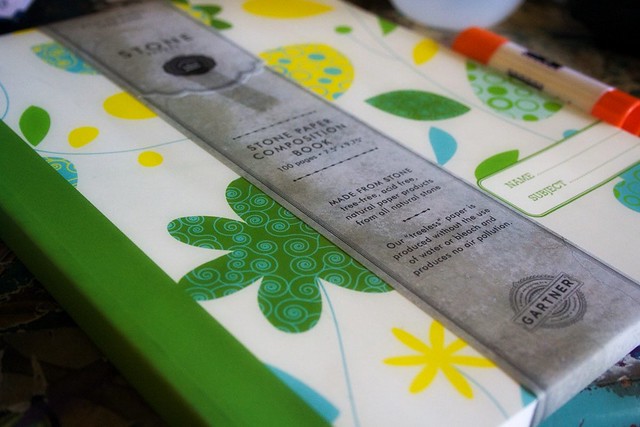
I went to Target this morning to pick up glue sticks, and while I was in the stationery section, I looked through their notebooks. I was looking for something with graph paper, but this one caught my eye instead. I’d never heard of stone paper! The first thing I noticed was that the notebook is heavy. It’s also (allegedly) acid free and 100% tree-free. The paper itself has a suede-like texture and is incredibly strong, like plastic sheeting. I tested both Sharpie and another brand of broad-tipped permanent marker on it, with absolutely no bleed-through. It does take slightly longer for gel pen to dry than it does on normal notebook paper, but given the rest of the positives, that’s a small point.

The only real negative is that it’s perfect bound, not sewn. That means that there’s no working across the gutter, and depending on how strong the glue is, pages may fall out. I’d be careful using wet media in it, because it could degrade the glued binding.
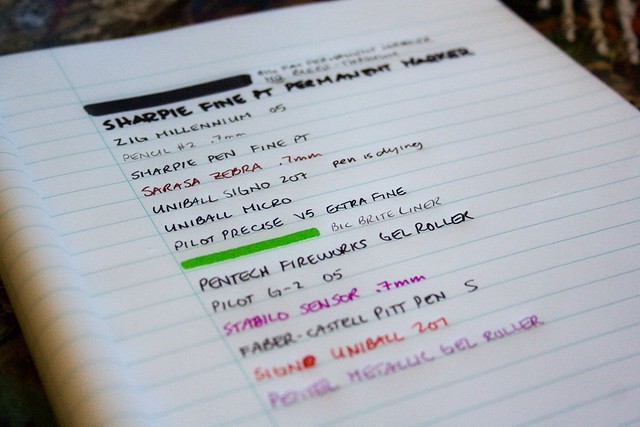
IMG_6970
Pen Test

Journals, Photography

January 7-13

100_5076
January 7-13

There’s nothing exciting on these pages, content-wise, but I thought I’d show why I wanted to use art paper in my planner. It’s cheap paper, but it works fine for watercolor pencil, Prismacolor, and Pitt pens. And, you can see why I complain about the lack of sunshine. This was actually a pretty good week, for Winter in Indiana.

Art, Collage, Journals

The End

End of 2007
The End of 2007
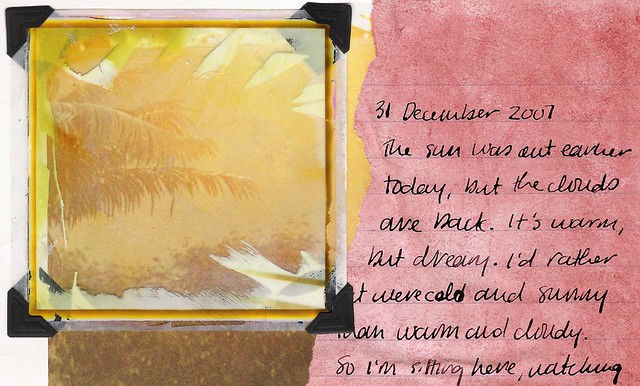
collage with Portfolio watersoluble crayon and India ink in composition book

One fringe benefit to writing on crayon is that the ink, which is otherwise permanent, will wipe away pretty well if you make a mistake, as long as you catch it while it’s still wet. A baby wipe works well for this, but I would think a wet napkin or tissue would do the trick, too. (Don’t ask me how I know this!)

Art, Journals, Photography

Composition Book Journal

100_4940

100_4937

I managed to finish up my current composition book journal last night. I don’t normally care if a journal is spread across two years, but since this one was nearly full, I thought it’d be nice to complete it.

These last pages were done with collage and Portfolio watersoluble crayons, using a dip pen and India ink for the writing. Like I said, this is about the only reliable way to write on some surfaces. In fact, at the art museum, one of my jobs was to put accession numbers on objects. For hard surfaces (metal, plastic, ceramic, etc.) we used a base coat of clear acrylic (nail polish will do in a pinch), then wrote the numbers with India ink and a dip pen, let it dry thoroughly, then put a protective top coat of acrylic over it.

Journals

Pens

Sun

The subject comes up periodically in just about every one of my art groups, of how to write on various media. Some pens just won’t write on some surfaces. One of the most difficult things to cover is watersoluble crayons. If you use them, and have tried to write over them, you know what I mean. A very thin application can usually be written on in pencil, Pitt pen, Prismacolor, oil pencils, etc. For thicker applications, about the only thing I’ve found that works consistently, without clogging, is an old fashioned dip pen and India ink.

Art, Collage, Journals

Harry and David Pears

The problem with my scanner being recognized was due to Zone Alarm. All is now well!

Pears
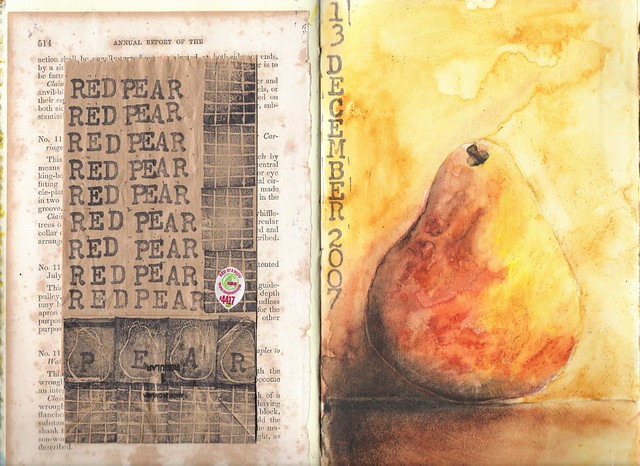
acrylic, Portfolio watersoluble crayons, eraser stamp, RoseArt ColorSharp metallic marker, fruit wrapper, and ink in composition book
9 3/4 x 15 inches

I messed around with this last night, while watching The Amazing Race. I was annoyed to see Kynt and Vyxsin go. Even when they had a melt-down, they did so without being mean to each other. Not an easy task, I think, under the circumstances. They did well, and they ought to be proud of themselves for that. Not so much the team that came in ahead of them. Aieee! I hope they’re sufficiently embarrassed by their behavior, but somehow, I doubt it.