


The Remembrance: A Tragedy in One Act
August-September 2007
5 1/8 x 4 3/8 inches
8 signatures of 2 sheets (32 pages with 18 final spreads)
brown paper grocery bags Coptic bound with hemp twine
The Remembrance: A Tragedy in One Act
August-September 2007
5 1/8 x 4 3/8 inches
8 signatures of 2 sheets (32 pages with 18 final spreads)
brown paper grocery bags Coptic bound with hemp twine


The Remembrancer: A Tragedy in One Act
5 1/8 x 4 3/8 inches
8 signatures of 2 sheets (32 pages)
brown paper grocery bags Coptic bound with hemp twine
This one is kind of small, both in dimensions and length. It’s also nearly square, which will probably make me cry before I finish it. Too bad I got gesso on the binding, because it actually turned out pretty well. It’s nice and even, without being too tight. That’s not so easy to accomplish with rough hemp, because the twin itself is knobbly, with thick and thin bits. I’ll try to clean up the gesso splotches and get decent close-ups of the stitching tomorrow. Or maybe I’ll decide it doesn’t matter.

Balancing Equations Journal, front
9 1/2 x 6 inches
collage (altered Polaroid, fragments from algebra book and dictionary, anatomical illustration, old dress patterns)
The paper bag journal has a name, now. Also, a front cover. The covers were made from recycled backs from old spiral-bound notebooks. On one of them, I’d written a bunch of figures while balancing my checkbook. I glued dress patterns over most of the numbers, partially obscuring them, but I kept the “Balance.
I really like the way the hemp cord looks, woven through the holes in the covers. I’ve left the ends long and dangling for now, and will probably attach something to the ends. Little brass or copper cow bells, maybe, but that’ll have to wait until I’m finished filling the book, because the noise might drive me nuts.

Top and Spine Detail
9 1/4 x 6 inches
brown paper grocery bags Coptic bound with waxed linen thread, 10 signatures of 2 leaves (40 pages)


Packing Paper Book
packing paper Coptic bound with silk thread
4 1/2 x 6 inches, 10 signatures of 5 leaves each (50 pages)
I got an e-mail from someone on Friday, asking me about the Coptic stitch tutorial I wrote. She wanted to know if there was any way to make the outer rows into full knots instead of half knots. If you’ve gone through the tutorial, you’ll have noticed that in the end rows, the needle enters the next signature, instead of going back into the same hole it came out of. That makes the end rows of stitches look a little less than pretty. It’s something that\’s bugged me, from an aesthetic viewpoint, but it’s inherent in the binding, and I wasn’t bothered enough to try to find a different method. The binding, as it is, is nice and easy and sturdy, which is my main concern. I toss these books into my bag and carry them with me for months at a time, so I know this binding method is strong and durable.
However, I’m all for improvement! So, I had another go at trying to think up an easy way to make all the rows of stitches identical. Usually, you would use one long, uncut piece of thread for the whole binding, working up and down the spine. This time, I treated each signature as a separate entity. The first signature is attached to the cover in the usual manner, but when you get to the end of the first signature, you wrap the thread around the stitch above it, then re-enter the end hole. Tie off the thread. Re-start the next signature, from scratch, etc., etc., etc. This way, the first and last rows of stitches are making a full pass around the stitches above them and are re-entered into the hole they originated from, forming a full, pretty knot instead of a half, ugly knot.
So, this was just a quickie experiment to test out how feasible this flavor of binding would be. The photos are not great, because the light was going and the wind kept blowing the pages around. At some point, I’ll give the binding another try, and get better pictures. I’m not sure how much I’ll use this binding method, though, because the extra knots at the beginning and end of each signature are a little unappealing. It also takes more time than my usual method, because of all the extra knotting. Maybe using something less slippery next time would help. Silk was a bad, bad choice for a lot of reasons.
Also, I found my iron! Of which I actually have two, because I temporarily lost my old one and had to replace it. Not that I iron very often. I don’t even own an ironing board. The only thing I use it for seems to be paper. It came in handy today, for flattening the packing paper I used in this book. Reduce, reuse, recycle, right? I can’t stand throwing away brown kraft paper, even though it’s not archival. I adore the stuff. And this stash of it is extra nice. It’s very thin and strong, with a hard, smooth texture (like sandwich bags, not grocery bags).


5 x 3 1/2 inches, 16 signatures (32 pages)
140lb Cotman cold press watercolor paper Coptic bound with cotton thread

The covers were recycled from the back panel of a notebook. At first, I was going to cut off the holes from the spiral binding, but they reminded me of sprocket holes in film, so I kept them. I haven’t done anything to decorate the covers yet. They’re just bare davey board.
The pages are made from watercolor paper. I bought a few sheets of it, to try it out, and didn’t end up liking it for painting. I held onto it, though, because I thought it might work in a book. We’ll see.
I was taught never to cut art paper, so I almost always tear my book paper. This time, though, I cut the fore edges with a pair of crafting scissors. The blades are supposed to mimic torn paper, which I think they do reasonably well. Since this book isn’t going to be used for watercolor, cutting with scissors won’t hurt anything.
(You can see by the orange flecks in the detail to the right that Miss Brown’s hair tends to get into everything.)


Little Boats
collage, gel pen, and acrylic on 140lb Cartiera Magnani hot press watercolor paper
3 x 7 1/2 inches
I wanted a change from bottles and vases and plain old doodling, so I thought I’d work on something else for awhile. I bound this miniature book, using left over scraps of paper and book board I’d pre-painted with acrylics, about a year ago, as a demo for a book binding tutorial I wrote. Because of the sea foam greens used on many of the pages, my intention was to eventually do something water-themed with it.
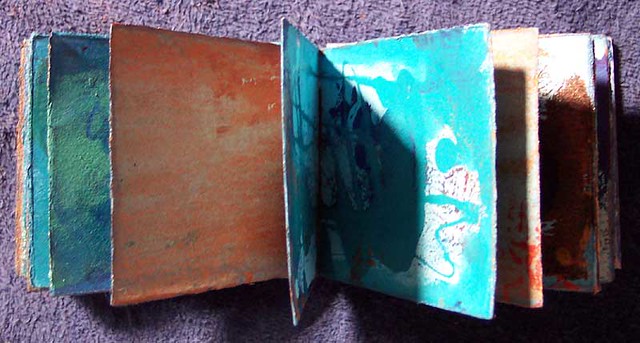
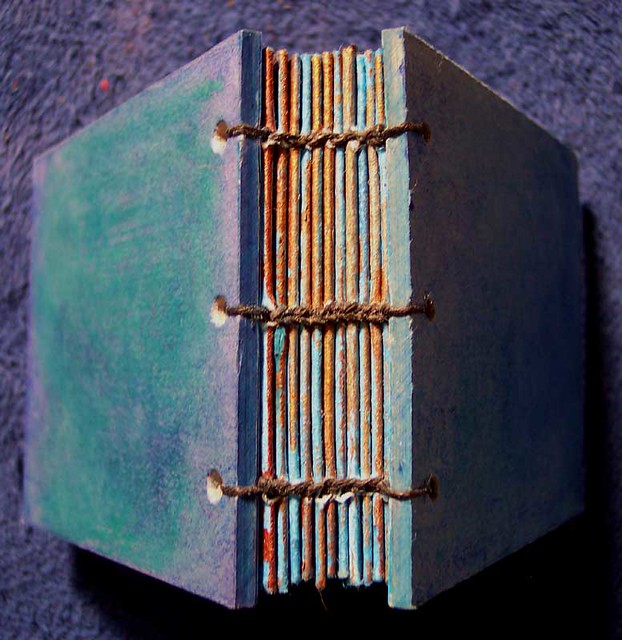

Little Boats
3 3/8 x 3 15/16 inches, 11 signatures of 2 pages each (22 pages total)
140lb Cartiera Magnani hot press watercolor pages, pre-painted with acrylics, bound with waxed linen thread
Hemp Bound Journal, finished (finally!). I started it in July of 2005 and quickly got sidetracked. I picked it up a couple of times, but didn’t get serious about finishing it until a couple of weeks ago. I still have to do a table of contents, and will post that when I’ve completed it, but for all intents and purposes, it’s done, done, done.


This, of course, means I am in need of a new journal. I’ve been trying to decide what paper I want to use. I’ve got some really nice 140lb Cartiera Magnani hot press left (God, I love that stuff!), but I decided to go with the black 90lb Stonehenge for now. I may regret that decision, though. It doesn’t take kindly to water. Not at all. But it’ll be fun to play with gel pens again. (Oooh! Shiny!)


Stonehenge Journal
7 1/2 x 5 5/8 inches, 11 signatures of 4 pages each (44 pages total)
Coptic stitch with linen thread, 90lb black Stonehenge paper
If you aren’t familiar with exposed spine bindings, and would like to try making your own books for writing or art, there’s an illustrated tutorial for how to do this binding on my website. It’s really not complicated. Tearing down and folding the paper to the size I wanted took about 30 minutes. The binding itself, including setting grommets into the holes on the front and back covers, took about an hour. I did the entire thing while watching television.
Speaking of television, I’m in the middle of watching the first season of Rome. Oh my. If you enjoyed I, Claudius (or I, CLAVDIVS, as I like to call it), then you’ll like Rome. It’s set during Julius Caesar’s reign, so it directly precedes I, Claudius. In fact, I’m going to rewatch I, Claudius as soon as I’m finished with Rome. I could use a good dose of Derek Jacobi.
Side note: While Googling for links for the above shows, I came across the Wikipedia entry for the Robert Graves book that I, Claudius was based on. And it contained a spoiler warning. Honestly, does a book about Roman history–even if it’s heavily novelized–really need a spoiler warning? The mind wobbles!

Coffee Book
5 3/4 x 5 1/2 inches, 12 sheets/24 pages
90lb cream Stonehenge paper stained with instant coffee, stab bound with ribbon and accented with aged brass brads
7 August 2006
I haven’t been either terribly busy or a total lazy-ass. I just haven’t had much to say lately. I’ve transcribed a few more letters (they’re uploaded, but not linked yet) and bound another little book, and I finally found the itty bitty ABC book I made last year, and got some better photos of that.
Instant review: How Art Made the World
I’ve watched the first disc (episodes 1-3) and am impressed with it. It’s very well put together. Art programs that appeal to both people who are in the art world and those who have no knowledge of it are rare. I think this is one of them, though. Even my neighbor, who swears she’s not artistic (ha!), enjoyed it and found it fascinating.
I got a kick out of the underlying premise that art is created by humans, and that humans were created by art. An ouroboros of sorts. I wrote something similar a few years ago:
However hard we may try, we cannot separate ourselves from the social structures that make us human. Art is the re-presentation of human experience. Art is dependant upon culture and culture is dependant upon art; man creates art and art creates man. Art is a dialogue between ourselves and our fellow humans concerning the world around us. Even if the “subject” of art is not linked to the human experience, the fact that it is created by persons with uniquely subjective outlooks on life makes it about the human experience.
I know the idea is not original, and that it has been around for a long, long time, but it’s not one that was ever discussed in my art history classes. It wasn’t until I got into the study of anthropology and history that the broader cultural aspects of art were addressed, in terms of why it exists and how it came to be.


Paper Bag Book
pages made from grocery bags, covers made from textured kraft paper, bound with hemp twine
12 four-sheet signatures (96 pages)
5 x 4 1/2 inches
Little Boats
140lb Cartiera Magnani hot press watercolor pages, pre-painted with acrylics, bound with waxed linen thread
11 single-sheet signatures (22 pages)
3 3/8 x 3 15/16 inches
[Edit: The interior artwork can be seen here.]
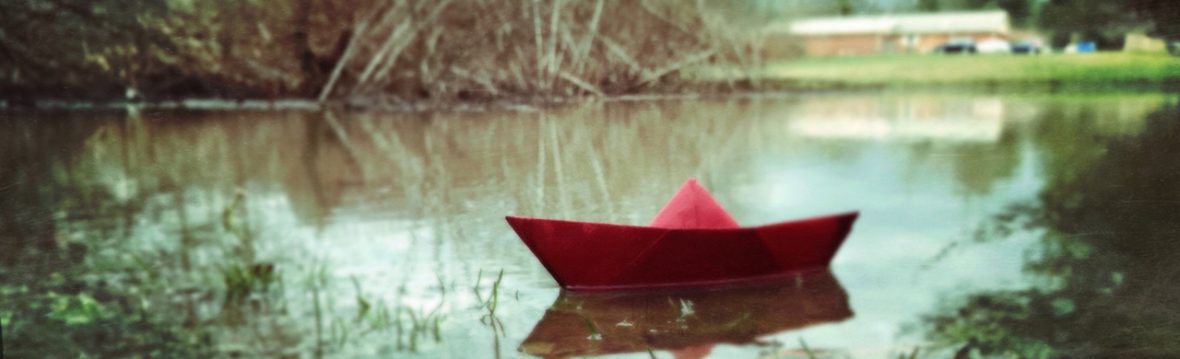
 red paper boat