
Some very well loved favorites.
Some very well loved favorites.

I found this photo in a book I was cataloging. I don’t get many books with photos, so it was kind of noteworthy for that, if nothing else. And then I saw this photo, taken in 1909. It’s of a “Rumpler-Taube,” an early German war plane meant to mimic the shape of a bird. The “skin” that would have covered the “skeleton” would have been painted with bird-like features.


From: The Eclectic Elementary Geography, Cincinnati: Van Antwerp, Bragg & Co., 1883.

Endpaper and Title Page, The Eclectic Elementary Geography, Cincinnati: Van Antwerp, Bragg & Co., 1883.

Men! Who! Do! Things! THINGS, I say! I’m guessing there wasn’t a corresponding series of books about “Women who do Things,” onna counta women don’t “do things.” That’s reserved for MEN. M’kaythen!
This was another of my junk shop finds in Minnesota. It was only 50¢, because it’s in really rough shape, but after seeing the title page, I just couldn’t resist.
All the diarists mention the Indians they meet on their journey. Most of the women’s descriptions fall somewhere between thoroughly ignorant and deeply racist. This passage is one of the few I’ve read that contains even a hint of awareness of the affect the white settlers’ movement westward was having on the peoples living on those lands.
May, 1851
Crossed the Missouri at Council Bluffs, where we had been a couple of weeks making the final preparations on this outskirt of civilization
The weather has been mild, and we have walked evry day over the rolling hills around — one day found a young physician and his wife who were interested in examining the numerous skulls and human bones that were found near the surface of the ground. After much speculation the fact was elucidated that, large tribes of Indians from the middle states had been pushed off by our government to this frontier region to make room for white settlers, and had here perished in large numbers by starvation consequent upon removal from familiar hunting grounds: they had been buried in large trenches with heads to the east. Skulls were thick: of peculiar shape differing from the Anglo Saxon type.
Clarke, Harriet Talcott Buckingham, 1832-1890, Diary of Harriet Talcott Buckingham Clarke, May, 1851, in Covered Wagon Women: Diaries & Letters from the Western Trails, vol. 3: 1851. Holmes, Kenneth L., ed. & comp. Lincoln, NE: University of Nebraska Press, 1995.

gel pen on paper, 5 1/2 x 7 1/2 inches
On August 20, 1853, Celinda Hines wrote, “Saw a commet very plain in the SW.” And again, on the 23rd, “The commet shown very brilliantly in the evening.”
Three days later, Celinda Hines’ father died crossing the Snake River. He was thrown from his horse and drowned. His body was never recovered. In her journal, Celinda wrote, “I will not attempt to describe our distress & sorrow for our great Bereavement.” And indeed, she did not. She tells the story of his death almost matter-of-factly, but her grief is even more palpable for her terseness. The next day she wrote, “Our camp was in a very pretty place but all was sadness to me.”
[Excerpts taken from Shipley, Celinda Elvira Hines, 1826-1905, Diary of Celinda Elvira Hines Shipley, August, 1853, in Covered Wagon Women: Diaries & Letters from the Western Trails, vol. 6: 1853-1854. Holmes, Kenneth L., ed. & comp. Lincoln, NE: University of Nebraska Press, 1995, pages 113, 114, 116.]
Medicine on the overland trails left something to be desired. Some of the remedies were common sensical. Others, while they may not have done much to help the patient, at least they wouldn’t have harmed or killed her.
Lucy Rutledge Cooke suffered greatly from ulcerations and swelling of her tongue and throat. This went on for weeks, while she tried various ineffective remedies. One of them involved drinking “sugar of lead,” or lead acetate. We know now that lead should not be ingested, but in the past it was used for everything from sweetener to face cream to–as seen below–sore throat remedy.
[May 29, 1852]
I was not able to eat any having got a very very bad mouth & throat my tongue is so swollen & in such ulcers that I m unable to speak much & can swallow nothing but liquids I never had my tongue in such a state
[June 6, 1852]
My throat continues very bad I used Suger of lead once, but it had such a curious taste & turned my teeth so black that I could not endure to use it again I now keep sucking alum which seems to cleanse my mouth but really I dont know if it does further good
[June 13, 1852]
I drink chocolate all the time since I’ve been sick. I’m thankful to say my mouth seems much better to day. I have been using a gargle made of sage tea, alum, borax & sugar & it seems to benefit
Cooke, Lucy Rutledge, 1827-1915, Letter from Lucy Rutledge Cooke to Marianne Rutledge Willis, May-June 10, 1852, in Covered Wagon Women: Diaries & Letters from the Western Trails, vol. 4: 1952: The California Trail. Holmes, Kenneth L., ed. & comp. Lincoln, NE: University of Nebraska Press, 1995.
We know now that cholera is spread by coming into contact with contaminated water. Bathing in water that could well be teeming with cholera bacteria seems now to be unwise at best. I’m not even sure how this cure was supposed, at the time, to have worked.
June 29 [1850]
We had the hardest thunder storm last night I have witnessed in some years. Started on this morning & soon came to a very bad road, low marshy land. A little before we stopt at noon there was a woman by the name of Beal died. She was buried on the banks of the Clearwater, a fine stream about 10 miles from where we came on the bottoms. They immersed 3 in this stream for the cholera. Travelled 14 miles & slept on a high spot on the marsh for the night. Met the Salt Lake mail, they said they met 8000 teams when they got to Fort Laramee. Since that they have not kept count. Wether very warm.
Parsons, Lucena Pfuffer, 1821-1905, Diary of Lucena Parsons, June, 1850, in Covered Wagon Women: Diaries & Letters from the Western Trails, vol. 2: 1850. Holmes, Kenneth L., ed. & comp. Lincoln, NE: University of Nebraska Press, 1995, pp. 294.

The Bloomer Costume, N. Currier (Firm), 1851, from the Library of Congress Prints and Photographs Online Catalog
Some of the covered wagon women took advantage of the new dress reform popularized by Amelia Bloomer. In the mid 1800s some women began wearing more comfortable, looser clothing characterized by short skirts with long, loose pants, or bloomers, worn underneath. These outfits allowed better freedom of movement and were much better suited to the westward journey than the usual long dresses and tight corsets most American women wore at that time.
[April 1852]
We have a plentiful supply of provisions, including dried fruits and vegetables, also a quantity of light bread cut in slices and dried for use when it is not convenient to bake. Our stove is furnished with a reflector oven which bakes very nicely. Our clothing is light and durable. My sister and I wear short dresses and bloomers and our foot gear includes a pair of light calf-skin topboots for wading through mud and sand.
Egbert, Eliza Ann McAuley, 1835-1919, Diary of Eliza Ann McAuley Egbert, April, 1852, in Covered Wagon Women: Diaries & Letters from the Western Trails, vol. 4: 1952: The California Trail. Holmes, Kenneth L., ed. & comp. Lincoln, NE: University of Nebraska Press, 1995.
[April] 17th [1852]
— Got up and put on a suit of short clothes [bloomers] to avoid the mud. Got out and walked and in passing one house the women came out and laughed at me or my dress, I did not ask which, but find it much more convenient for traveling than a long one.
Cummings, Mariett Foster, 1827-, Diary of Mariett Foster Cummings, April, 1852, in Covered Wagon Women: Diaries & Letters from the Western Trails, vol. 4: 1952: The California Trail. Holmes, Kenneth L., ed. & comp. Lincoln, NE: University of Nebraska Press, 1995.
May 23 [1852]
— Sabbath. We camped this afternoon at 3 o’clock, to rest the remainder of the day. We have been traveling, for several days, in company with an old gentleman, and his family. He has with him, his wife, two sons, daughter and daughter’s husband. The daughter is dressed in a bloomer costume — pants, short skirt and red-top boots. I think it is a very appropriate dress for a trip like his. So many ladies wear it, that I almost wish that I was so attired myself. The old lady wears a short skirt and pantletts. She is fifty years old. Her health was not good when she started, but it is improving now. Distance traveled, sixteen miles.
Sawyer, Francis Lamar, 1831-, Diary of Francis Lamar Sawyer, May, 1852, in Covered Wagon Women: Diaries & Letters from the Western Trails, vol. 4: 1952: The California Trail. Holmes, Kenneth L., ed. & comp. Lincoln, NE: University of Nebraska Press, 1995.
Some of the women speak rarely, if ever, of their babies. Lucy is not one of them. I think that’s due to the fact that she was writing letters home to her sisters instead of keeping a regular journal. Her family would surely have wanted news of little Sissy’s progress.
Aside from giving regular updates of her progress in weaning Sissy, Lucy also talked about the baby’s developmental milestones: walking, talking, teething, and potty training. This is the first time I’ve heard the word “occasions” used in this way, and the crudity of the subject matter juxtaposed with the oblique primness of the description made me laugh.
[October 1852]
I have not said a word about dear little Sissy. she is not weaned yet & I guess I shall not do so till spring she does not talk yet & has not run about more than a month She has 8 teeth all cut since she was a year old & strange she cut her eye teeth first She’s a cunning puss knows all we say tell Mrs Wright she has 2 great faults which I am continually whipping her for one is poking her fingers into the bread when set to rise the other is opening my box & sitting on the top of things & twice she did her occasions in it.
Cooke, Lucy Rutledge, 1827-1915, Letter from Lucy Rutledge Cooke to Marianne Rutledge Willis, October, 1852, in Covered Wagon Women: Diaries & Letters from the Western Trails, vol. 4: 1852: The California Trail. Holmes, Kenneth L., ed. & comp. Lincoln, NE: University of Nebraska Press, 1995.
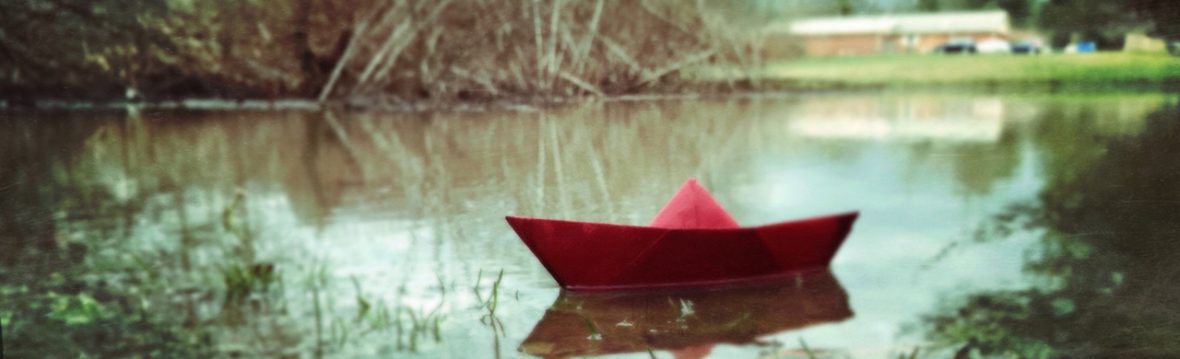
 red paper boat