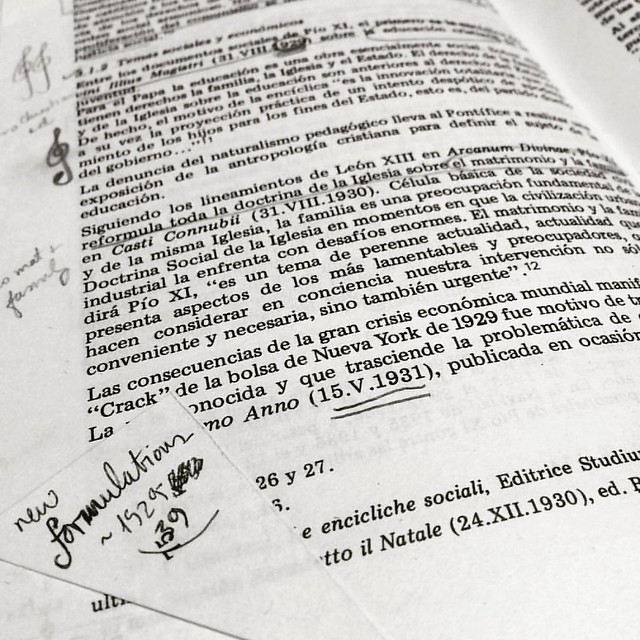
I worked today, because I will need to take time off Tuesday to pick up my car. One of the books I cataloged was a gift, and it was full of marginalia and annotated dog ears.
I know writing in books makes some people break out in hives I love it, though.
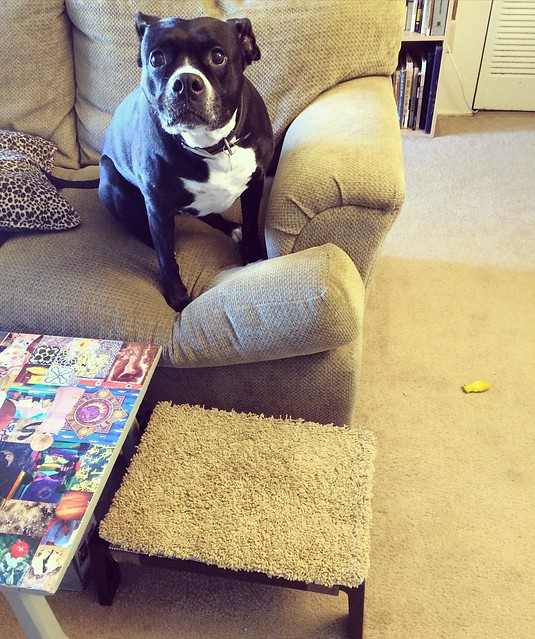
I also got a super cheap step for Frances. I attached a piece of carpet to the top, and she’s used it about fifty times already today, to get on and off the couch.
Between her crappy knees and the arthritis in her spine, she’s been really reluctant to get on the couch and the bed. I’ve been worrying about how to help her out, so I’m glad she’s willing (and eager!) to use her new step.
Sweep, sweeping, swept. The curving bits are only marginally better. Was she sleepwriting? Was her editor drunk?
I don’t read Agatha Christie often. The racism, sexism, and classism may be dismissable as typical for her social group at the time, but the older I get, the more appalling they become. But it was $1.99 in the Kindle
store, so I thought, “What the hell?”.
The hell, indeed. It has plenty of our old friends, sexism, racism, and classism, along with some new isms. It also contains some shockingly bad writing.
A couple of those items needed completely new records. All but a few had required at least some (and often a LOT) of editing. And that doesn’t include the stack of things that went to our NACO person to have authority work done.
If you’ve done national level enhance cataloging, you will understand that that’s a lot of books to chew through in one day.
Please file under G for “getting shit done.” I’m going home now to partake of an adult beverage.
Jackie sent me a link to this beautiful 1918 animated film about the sinking of the Lusitania.
And that reminded me of a family story that’s somewhat apocryphal. Or maybe not?
My great grandmother, Nell Basquille, came to the US from Castlebar, Ireland, in 1916 on the SS Philadelphia. The ship arrived in New York on 1 October. The story goes that there was a fire on-board the ship while it was waiting in port. Given the time period, there was much speculation that it may have been deliberately set by German agents or Nazi sympathizers.
But I say the story is somewhat apocryphal, because I’ve never been able to turn up any reliable mention of it in various fits of researching. Just a single passage in a book whose author’s credentials are unknown to me. But the incident is mentioned there, and surely if it weren’t true, two different people wouldn’t have dreamt it up independently?
So even if he doesn’t list his sources (and as far as I can tell, he does not), Landau at least does mention the fire, which leads me to believe it actually happened. Probably.
The best gift I have given is a key chane I gave to my dad
Late last night I got tired of dysentery and death on the Oregon Trail and switched to reading Nancy Drew. This was tucked into Password to Larkspur Lane.
I didn’t make it a full 24 hours. Sometime after 2am I fell asleep mid-word.
Elizabeth’s husband fell sick on the journey. He made it to Portland, but had to be carried to their leaky, lean-to shed and laid upon what was to become his deathbed. He lingered for two months, before finally dying.
feb 1 [Tuesday] rain all day this day my Dear husband my last remaining friend died.
feb 2 to day we buried my earthly companion, now I know what none but widows know that is how comfortless is that of a widows life espesily when left in a strange land without money or friends and the care of seven children — cloudy
Geer, Elizabeth Dixon Smith, 1808/9?-1855, Diary of Elizabeth Dixon Geer, 1-2 February 1848, in Covered Wagon Women: Diaries & Letters from the Western Trails, volume 1: 1840-1849, page 146. Holmes, Kenneth L., editor & compiler Lincoln, Nebraska: University of Nebraska Press, 1983.
That Spring, Elizabeth and her children left Portland, which she described as a “sick game place.” They settled in Yamhill County, and she soon married a man named Joseph Geer.
Imagine traveling by ox and wagon across the country, with no access to medical care, and only a few scant “medicines” at your disposal.
passed through St Joseph on the bank of the Missouri laid in our flour cheese and crackers and medicine for no one should travle this road without medicine for they are al most sure to have the summer complaint each family should have a box of phisic pills and a quart of caster oil a quart of the best rum and a large vial of peppermint essence. we traveled 4 miles the river and encamped here we found nine waggons bound for oregon.
Geer, Elizabeth Dixon Smith, 1808/9?-1855, Diary of Elizabeth Dixon Geer, 3 June 1847, in Covered Wagon Women: Diaries & Letters from the Western Trails, volume 1: 1840-1849, page 119. Holmes, Kenneth L., editor & compiler Lincoln, Nebraska: University of Nebraska Press, 1983.





 red paper boat