Samuel was my 6th great grandfather. At the time of the 1840 census–just five years before his death–he owned 21 slaves. I transcribed the document as well as I could, because unlike the census, it contains the names of the slaves he bequeathed to his survivors. Three slaves were left to his grandson, Samuel (my 4th great grandfather). At the time of the 1850 census, the grandson still had two slaves, a woman and young female child. By the 1860 census, he had no slaves.
This was obviously the period leading up to the Civil War. I wonder what prompted his divestment of slaves? Did he see the writing on the wall? Or did he have a conscientious epiphany?
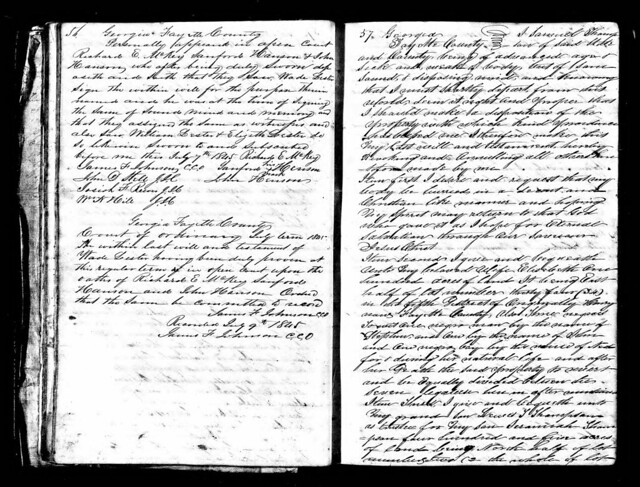
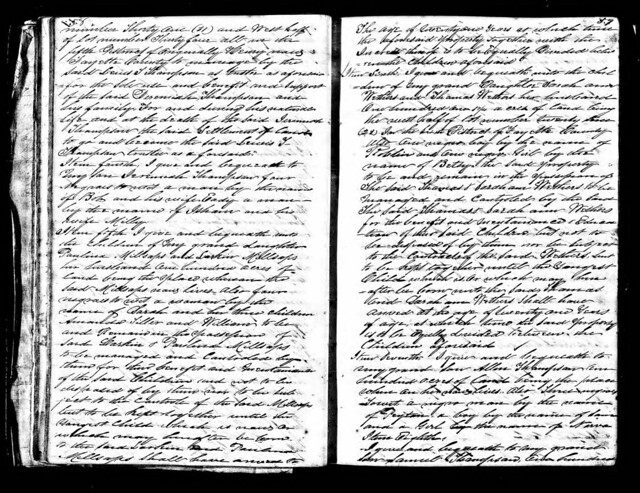

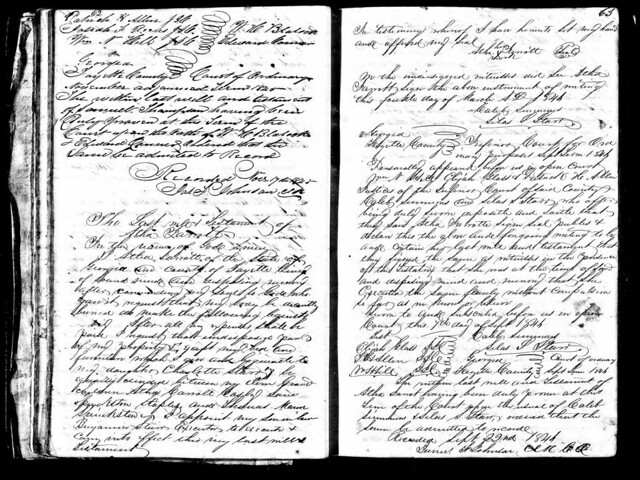
Georgia, Georgia, Wills and Probate Records, 1742-1992, Samuel Thompson will, signed 9 Oct 1945, proved 17 Nov 1845; citing Wills Book A 1823-1897, Fayette County, Georgia: Court of Ordinary, 1845, pages 57-62; digital images, Ancestry, Ancestry (https://www.ancestry.com/ : accessed 3 Jun 2017). Repository: Ancestry, 360 West 4800 North, Provo, Utah 84604
Georgia
Fayette County}
I Samuel Thompson son of said State and County being of advanced age & sick and weak of body, but of sane sound, & disposing mind, and knowing that I must shortly depart from this world, deem it right and proper that I should make a deposition of the property with which kind providence has blessed me. I therefore make this my last will and testament, hereby revoking and annulling all other heretofore made by me.
Item First. I desire and request that my body be buried in a decent and Christian like manner and hoping my spirit may return to that God who gave it as I hope for Eternal Salvation through our Saviour Jesus Christ.
Item Second I give and bequeath unto my beloved wife Elizabeth one hundred acres of land. It being East half of lot number thirty four (34) in the fifth District of originally Henry now Fayette County. Also, three negroes To wit one Negro man by the name of Stephen, and one by the name of John and one negro boy by the name of Ned for & during her natural life and after her Death the said property to revert and be Equally divided between the seven legateese here in after mentioned
Item Third, I give and bequeath unto my grand son Lewis T Thompson as trustee for my son Jeramiah Thompson four hundred and five acres of land being North half of lot number two (2) the whole of lot Thirty one (31) and West half of lot number Thirty four all in the fifth District of originally Henry now Fayette County to manage by the said Lewis T Thompson as trustee as aforesaid for the sole use and benefit and support of said Jeremiah Thompson and his family For and during his natural life and at the death of the said Jeramiah Thompson the said Settlement of lands to go and become the said Lewis T Thompson trustee as aforesaid.
Item fourth, I give and bequeath to my son Jeremiah Thompson four Negroes to wit a man by the name of Bob and his wife Eady a man by the name of Isham and his wife Milly.
Item fifth I give and bequeath unto the children of my grand daughter Paulina Millsaps and Larkin Millsaps her husband one hundred acres of land being the place whereon the said Millsaps now lives. Also four negroes to wit a woman by the name of Sarah and her three children Amanda Tiller and William to be and remain in the possession of said Larkin and Paulina Millsaps to be managed and controlled by them for their benefit and Meantainance of the said children and not to be disposed of by them nor to be subject to the control of the said Millsaps but to be kept together until his youngest child which is now or is or may hereafter be born to the said Larkin and Paulina Millsaps shall have arrived at the age of twenty one years at which time the aforesaid property together with the increase hereof is to be equally divided between the children aforesaid.
Item sixth. I give and bequeath unto the children of my grand daughter Sarah Ann Wethers and Thomas Wethers her husband one hundred one & 1/4 acres of land being the west half of lot number twenty three (23) in the Sixth District of Fayette County also one negro boy by the name of Robbin and one negro girl by the name Betty. The said property to be and remain in the possession of the said Thomas & Sarah Ann Wethers to be managed and contoled by the said Thomas & Sarah Ann Wethers for the benefit and mentainence & education their said children, but not to be disposed of by them nor be subject to the controls of the said Wethers, but to be left together until the youngest child which is or which may hereafter be born unto the said Thomas and Sarah Ann Wethers shall have arrived at the age of twenty one years of age at which time the said property is to be equally divided between the children aforesaid.
Item seventh. I give and bequeath to my grand son Allen Thompson one hundred acres of land being the place where on he now lives. Also three negroes to wit a negro man by the name of Peyton, a boy by the name of Sam and a Girl by the name of Nerva.
Item Eighth:
I give and bequeath to my grand son Samuel Thompson, one hundred acres of land being the place whereon he now lives. Also three negroes to wit a woman by the name of Silly & a Negro boy the name of Henry and a Girl by the name of Martha
Item ninth
I give and bequeath to my grand son James S Thompson the South half of lot of land number two (2) in the fourth District of originally [Henry?] now Fayette County also two negroes to wit a boy by the name of Joe and a Girl by the name of Phillis.
Item tenth. I give and bequeath to my grand son Lewis T Thompson one hundred and one and 1/4 acres of land being the East half of lot number twenty three (23) in the Sixth District of Fayette County also three negroes to wit a boy by the name of Robin son of Silly a boy by the name of Mishack and a boy by the name of Lewis
Item Eleventh, all the rest of my real estate wherever it may be, together with all the rest of my personal property consisting of horses, hogs cattle sheep etc all my farming utensials smiths tools of house hold and kitchen furniture to be sold by my executors hereinafter named, and after paying off all my just Debts out of the proceeds thereof the ballence to be equally divided between the Eight legatees hereinafter mentioned.
Item Twelfth
I constitute and appoint my grand son Lewis T Thompson and worthy friend Thomas Weathers my Executors of this my last will and Testament this ninth day of October in the year of Our Lord Eighteen hundred and forty five.
Samuel Thompson
Signed, Sealed and Delivered and Published, by Samuel Thompson in the presence of us the subscribers Who subscribed our names hereto in the presence of said testators and each other this October 9th 1845.
Thos Bynum
W. H. Blalock
Edward Conner
Georgia
Fayette County}
Inferior Court for Ordinary Purposes, November adjourned term 1845. Personally appeared before us in Open Court Elijah Glass Wm N Hill, Patrick H Allen & Iasiah F Reeves, Justices of this Inferior Court for said County, Wm H Blalock & Edward Conner, who after being Duly sworn deposeth and saith that they saw Samuel Thompson
Sign Seal Publish and declare this the above and foregoing writings to be and contain his last will and testament that they signed the same fully without compulsion so far as all know or believe. Sworn to and subscribed before us this 17th day of November Eighteen forty five
Patrick H Allen JIC
Iasiah F Reeves JIC
Wm N Hill JIC}
W H Blalock
Edward Conner
Georgia
Fayette County}
Court of Ordinary November adjourned term 1845 The written last will and testament of Samuel Thompson having been duly proven at this term of the court upon the oath of W H Blalock & Edward Conner ordered that the same be admited to record
Recorded Nov. 17th 1845
Jas. F Johnson clk
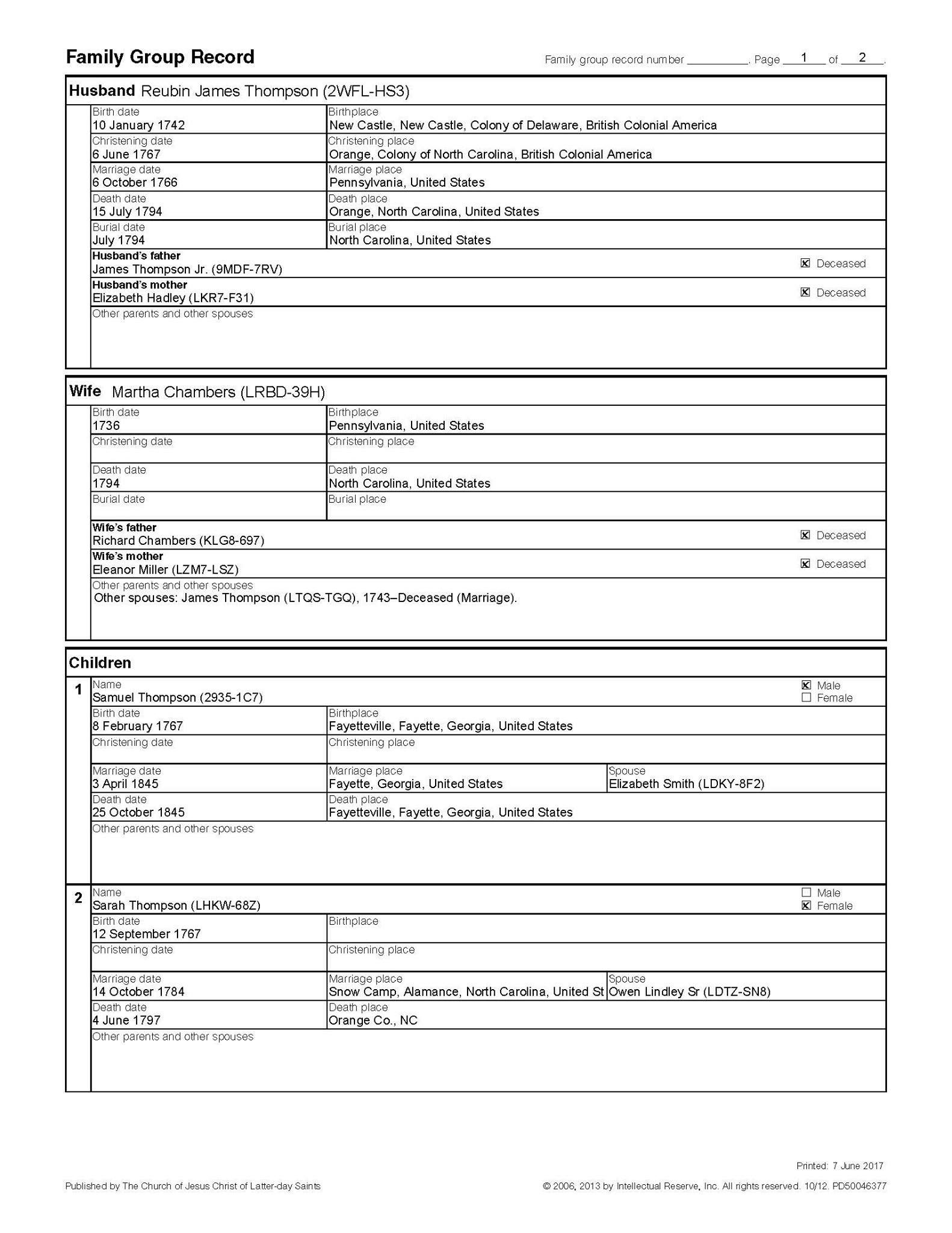 This is a problem. I find a whole slew of trees, including the world tree at FamilySearch, that have Samuel (my many times great grandfather) attached as a son to Reuben James Thompson and Martha Chambers. James Thompson and Martha Chambers were Quakers who married in 1766 in Delaware Colony, as this family group sheet from FamilySearch would indicate. There are marriage and will documents to support that. But at some point they migrated to Orange County, North Carolina. There is no indication that:




 red paper boat