
My life is all about Québec these days. I also have a request in for a historic atlas of Canada. Maps are always helpful.

My life is all about Québec these days. I also have a request in for a historic atlas of Canada. Maps are always helpful.
 My aunt sent me a link to a maritime history site that had searchable newspaper extracts. I was able to track down another website with archived images from one of the newspapers, where I found this ad in the Daily British Whig (17 June 1871, page 2, column 6).
There’s no way to know which Captain Couvrette was piloting the Union. It could have been Louis Charles or his (I am presuming) brother, George, who was also a boat captain.
I have spent weeks concentrating on Louis Charles and Philomene’s family group. I haven’t even begun to investigate laterally, so Captain George Couvrette will have to wait until I get the time to untangle Louis Charles’ siblings and figure out who was who.
My aunt also uncovered evidence of some Couvrettes settling in the Red Lake area of Minnesota (Joseph Couvrette appears to have married a native woman named Mari). That wouldn’t be far, geographically, from the Crookston area, where Louis Charles finally settled. I have no idea where the relation between Louis Charles and Joseph is, but there is sure to be one. That’s another puzzle to add to the To Research list.

Yes, this AGAIN.
I am convinced, though I have only negative proof, that Marie Catherine and Alma are the same person.
1. I have a baptismal register entry for Marie Catherine in 1862 but none for Alma.
Both the younger and older siblings Marie Catherine and Alma are sandwiched between were baptized at St-Joachim in Châteauguay, so it makes sense (though is no guarantee) that any children born in between would have been baptized there, as well. I have manually searched every page of the St-Joachim register for those years, to no avail. If there was another child born to Louis Charles and Philomene, between their youngest and Louis, she wasn’t baptized at St-Joachim.
2. I have found no trace of Marie Catherine after her baptism.
She does not appear in any census, and as far as I can tell, there is no record of her marriage or burial. She disappeared into thin air. Granted, she was born in 1862 and the next census was in 1871, and a lot can happen in nine years.
3. The 1901 Census of Canada recorded exact birth dates, and Alma’s is given as 25 November 1863. Now, that’s a year off, but the month is correct. It’s absolutely possible that two children could be born nearly exactly a year apart, especially in a large Catholic family at that place and time. However, I think it’s also possible that adult Alma was wrong about her birth year. That seems like a believable mistake.
4. What was Alma’s baptismal name? Surely it would have been prepended with Marie and another name, as was the norm in this family. Nor does the baptismal register give any indication of what Marie Catherine’s third name would have been. That’s the name she would have gone by in regular life. Was there one child, named Marie Catherine Alma?
I’m not ready to merge the two individuals, but I may eventually do so, after a bit more searching. By 1868, the family had changed churches, and the next batch of children were baptized and buried at Sts.-Anges-Gardiens, in Québec. That register is a little more difficult to search (it’s much larger than St-Joachim’s register and is not indexed), so I haven’t searched it thoroughly yet. It may be that Marie Catherine’s burial is recorded there.
Y’all, this is the stuff that keeps me up at night.

Quebec Official Gazette volume XII number 44 page 55
When all else fails, use Teh Googles. Which I did this morning, during my work break. And look what I found! I’m not completely sure what it means, but it’s kind of interesting nonetheless. Philomene is, for some reason, suing Louis Charles for separation of property. This was often done at or right after marriage, to ensure the wife had property of her own (though that could work against her, too, in the event of a divorce). In this case, they’d been married for 19 years and had 16 (SIXTEEN!) children. The marriage was no spring chicken. Separation of property could also occur at the time of divorce. But that doesn’t seem to have been the case, either, as the couple–together and with their minor children–upped stakes and headed to Minnesota just a few years after this notice was published.
Did Philomene intend to file for divorce, but then changed her mind? Was she trying to protect the couple’s assets (or at least, her share of them)? Was she trying to put the fear of God into Louis Charles? Was the move to Minnesota somehow tied up with all of this?
Interestingly, the couple were living together at the time of the 1885 Minnesota census, but Philomene is not in the home during the 1895 Minnesota census. I have no idea where she was between 1885 and her death in 1904. Maybe the 1895 census is a fluke, and she was living with the family but was off visiting someone on the day the census was enumerated?
And for good measure, the most recent family group screen shot. If you look closely, you’ll see that not all the children fit on the screen. That may be the definition of TOO MANY KIDS.

Drouin Collection, Baptismal Register for Louis Charles Couvret 1833
I spent five hours today, searching for my great-great grandfather’s baptismal record. The name in the index was so weirdly misspelled that I wasn’t hitting it, even using wildcards and narrowing by keyword. It had to be there somewhere, though. I knew the where and the when, based on the baptismal dates of the other children and where they were baptized, so I ended up searching for all baptisms at the Basilique Notre-Dame in Montréal, limited by the year 1833. From there, I had to view images of dozens and dozens of pages, before finding the one I wanted.
Victory is mine!

I put up a shelf, above my desk. And that’s about all I accomplished today. I’m still in the midst of filing hell. I’m down to one box of unidentified, unlinked Basquills. Some of the papers go to people I’ve already entered into my database, but most aren’t. And all of them need to have files made, once I’ve identified/entered their info.
Exciting stuff!

Drouin Collection, Baptismal Register for Marie Joseph Herman Couvrette, 22 December 1872
I knew my great grandfather’s baptism had to have been recorded, but I couldn’t find the record. I tried everything I could think of, including searching by the names Marie and Joseph, singly and together, as those two names were part of the naming convention for that family (the third or sometimes even fourth name would be the name the child went by).
I decided the transcription used for the index page must be so mangled that I wasn’t going to be able to use it to find what I was looking for. Instead, I found the names of the two churches where his next youngest and next oldest siblings were baptized. I knew Armand’s birth year (and could be certain it was correct, because of how closely together all his siblings were born), so I could then search the register page by page, looking for him.
And I hit pay dirt. There he was, very clearly listed as Marie Joseph Herman Couvrette, son of Louis Charles Couvrette and Philomene Chauvin. I’d been searching for Armand, because that’s the name he went by his entire life. Herman is a reasonable variation of that. However, when I finally was able to locate the index entry for this page, I saw that someone had transcribed his name as M Joseph Norman Courrette. No wonder I couldn’t find him!


There were a total of 16 children. There are too many to all show on the family group screen, so the last one is on the next page. Her name is Marie Josephine Flore, the same name given to a younger sister who died as an infant. That’s a lot of kids.
I still have a few to try to track down baptismal records for. Hopefully my luck will hold.
Before

After
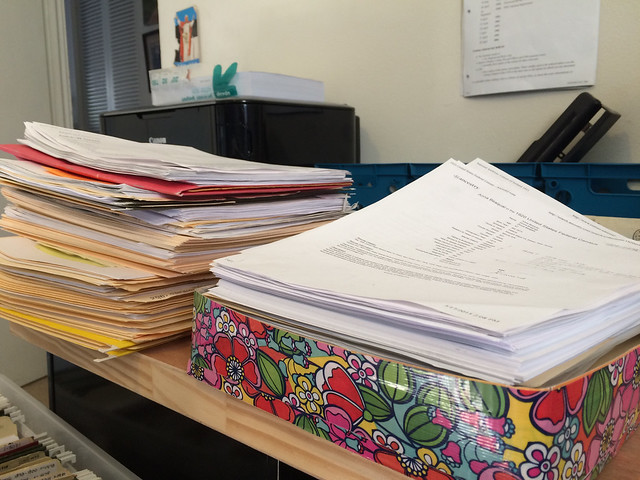
I did a huge amount of filing genealogy papers today. I’m still not done, but the Unspeakable Pile is about 1/3 the size it was. Unfortunately, what’s left are all “strays” from my Basquill name study. I’m not sure how I’m going to tackle them. That’s a project for another day, though.

Baptismal register, Marie Josephine Honorine Couvrette, 13 October 1868

Burial register, Marie Josephine Honorine Couvrette, 18 November 1868
I was trying to find the rest of the baptism and burial records for the children of Louis Charles Couvrette and Philomene Chauvin. What I found was at least one more daughter I hadn’t encountered before. And no wonder. She only lived a little over a month.
Another sister died on 26 November 1868. I can’t make out her fourth name, and until the rest of the older daughters are accounted for (burial records or evidence that they lived beyond 1868), I can’t rule out the possibility that the stray isn’t actually just a name variant for one of the older children.
In any event, 1868 was not a good year for the family.
On a slight tangent, these two entries are good illustrations for the indexing method that was common for church registers. The person’s name would be entered in the margin, and usually a large capital B (baptism), M (marriage), or S (sepulture, I believe?). This makes it a little easier to scan the registers for entries. Easier, but not easy.
Dig deeply enough into your family history, and if you have French or French Canadian ancestors, you will uncover a dit name. These can be a little confusing, if you’ve never seen one before.
Dit is a form of the verb dire, which means “to speak.” In this context, it means “was called.” So Nicolas Jahan dit Denys = Nicolas Jahan “called” Denys. It means that he was formally known as Nicolas Jahan, but for some reason the name was changed to Denys. Most likely, given the time and place (18th century Quebec), he was a recent immigrant and the name change coincided with his family’s move from France to Canada. Hopefully more research will clarify the when, if not the why.
I came across my first dit name last weekend: Marie Celeste Jahan dit Denys (daughter of the aforementioned Nicolas). In trying to figure out what this funny word meant and how to properly record it, I took a look at her in Ancestry.com’s public trees and found a variety of ways people have handled her name.

Marriage Registry from the Drouin Collection for Francois Caillet and Marie Celeste Jahan dite Denys, 22 November 1726, Neuville, Quebec[2]
And then last night someone shared a link to a blog post on the Legacy User Group, on dit names. How timely! I in turn shared the post on Facebook, and a friend commented that she’s run into dit names in French dog pedigrees. Before the 1920s, French kennel names weren’t widely used as part of the dog’s registered name. The dit names would have reflected both the formal name and the dog’s call name.
My friend also mentioned that she’s seen the feminine form, “dite” in pedigrees, but didn’t know if that was just an archaic usage.
Hm. I double checked my source image, to make sure I’d transcribed the name precisely, and sure enough, it looks like it ends in -e. That doesn’t answer the “Is dite still used?” question, but I feel secure in using it for Marie Celeste, who was married in 1728.
And then my brother and another Facebook friend started language-geeking about dit vs. dite, and lo and behold, it is a legitimate feminine form in current usage.
____________________________________________
1. The spelling of the family name Denys seems to have changed to Denis during Marie Celeste’s lifetime, and the name Jahan dropped entirely by the time Marie Celeste died.
2. Unfortunately Ancestry.com has no index entry for her name, for the marriage register image. It’s only indexed under the name of her husband, Francois Caillet. That means that I cannot file a transcript correction for her. Very annoying!
 red paper boat