
Pears (in progress)
oil on canvas\r\n\r\n
This one is fairly large (32 x 48 inches), and this is not the only pear in it, but it’s the farthest along. It’s still just underpainting, though.
Pears (in progress)
oil on canvas\r\n\r\n
This one is fairly large (32 x 48 inches), and this is not the only pear in it, but it’s the farthest along. It’s still just underpainting, though.


oil on canvas (details)

I was noticing yesterday that the plastic coating is wearing through around the viewfinder of my camera. I got it almost three years ago. It’s been a good little camera (as long as you don’t want in-focus photos of painted canvas!), but I think it may be time to upgrade.

I added another layer this morning. This is only the left-hand side of the canvas. It’s actually in landscape format, not portrait.
It’s been a few years since I’ve really painted in oils. I don’t know why, maybe because I’ve been sidetracked by working in books. Anyway, I forgot a lesson I learned years and years ago: be careful to cover the wall behind where you are working. Oops! I now have a lovely spattering of fine dark teal polka dots on the wall above my work bench. I need to re-read my lease. I’m pretty sure that it says that they don’t charge for re-painting if you live in a unit for two or more years. I hope so!

This is just the first layer. It’s a little more army green than I’d intended, but it’ll eventually be mostly blue.
I hate working with paint thinner, but there is just no other way to get this sort of spidery wicking of the paint.
True story: In a rebellious fit of stupidity, I once tried to use a mixture of linseed oil and paint thinner. The drippy effect was pretty good, but apparently, I’d used too much linseed oil and too little thinner. When I went back to the studio the next day, the entire painting had slid off the canvas. Weird, huh?
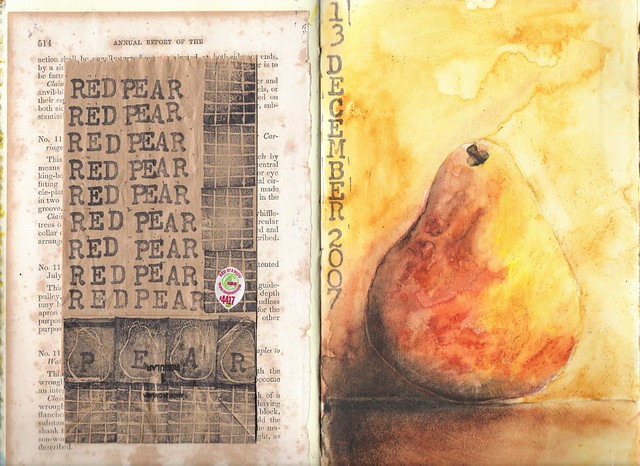
Red Pear (detail)
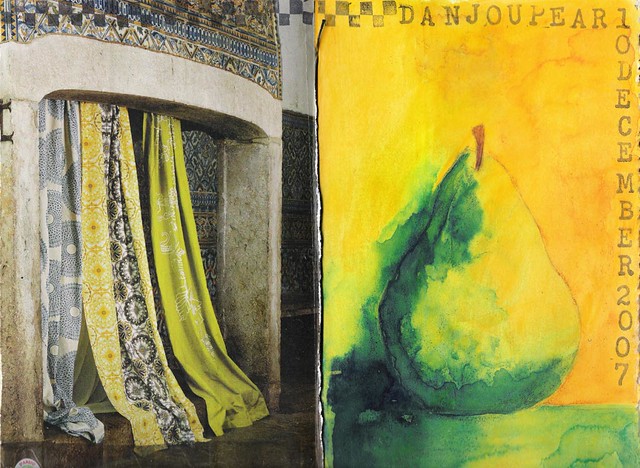
d’Anjou Pear
collage with Neocolors II and eraser stamp on 90lb Stonehenge paper
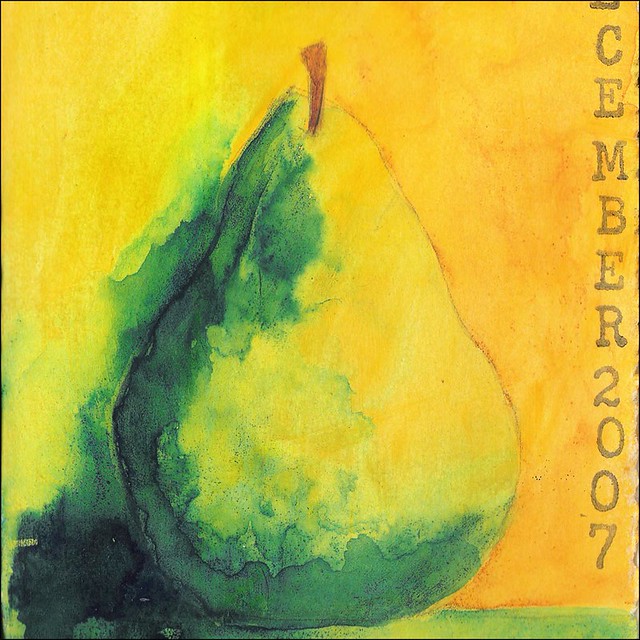
Detail
I have one pear left to do, plus the title page and, if I feel inclined, the cover. Now that the project is nearly over, I guess it’s about time that I got a blue/yellow one that I like. And in eeevil watercolor, no less!

Bosc Pear (detail)
I like the way this one turned out. I glued down a page from an 1850s patent book, using acrylic medium, then topped it off with a layer of medium, to seal it. Otherwise, as soon as you add water to it, the paper peels and rolls up.
The under-layer of pigment was done in a really wet wash, with the upper layers being finger blended, without adding water.
The detail is about 50% larger than usual, which shows the texture pretty well. The swirly marks are from the underlying layer of acrylic medium. The sharp chisel marks around the dark edge of the pear are from an Xacto knife. Scratching into the paper not only mimics the reflected light, but it also creates a barrier, stopping the watercolor from flowing outside the area.
Tomorrow, I’m going to make pear crisp. Mmmm!

d’Anjou Pear
collage with watersoluble crayon and acrylic on 90lb Stonehenge paper
9 1/4 x 11 5/8

Detail
 red paper boat