
The Terrible Hours: Cut Two
collage (stencils, cut-out dolls, child’s dress pattern, and anatomical illustration)
9 1/4 x 11 3/4 inches
Category: Art
The Terrible Hours
I started working on a new altered book today: The Terrible Hours. It’s about a submarine rescue, I believe. I’m not a big fan of disaster stories, so I haven’t actually read it. I picked it up at the Mission thrift store because it was a nice size for altering, in good shape, and I liked the title.

The Terrible Hours: Sealed Against the Sea
collage (map, glass, and anatomical illustration) with Neocolors II and gesso
9 1/4 x 5 7/8 inches
My scanner doesn’t handle depth very well, and because there are shallow niches cut out of the pages, the furthest layer is out of focus. I’ll try to get a photo of it tomorrow, when there’s decent light.
Now, to go watch SiCKO, now that I have finally managed to get a clean copy of it.
Maya Chacmool
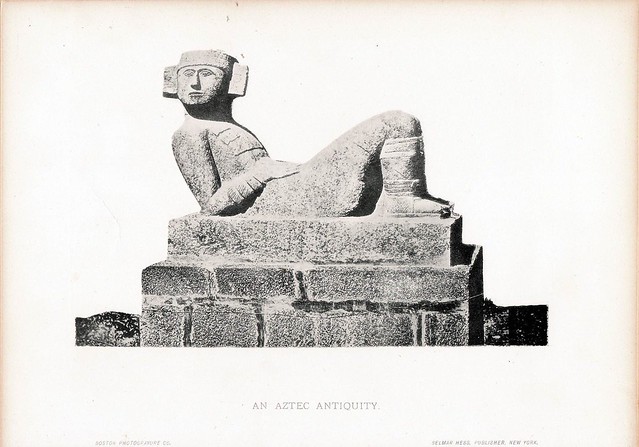
Maya* Chacmool figure, Photogravure, 7 1/2 x 10 3/8 inches
I forgot I had this. I unearthed it while digging through a box of ephemera, looking for old maps to cannibalize for collage. It was given to me by the director of the art museum when I was researching objects from their Precolumbian collection. The engraving is of a Chacmool excavated by Augustus Le Plongeon at Chichen Itza in 1875.
Chacmool are a type of Precolumbian stone figures thought to be associated with ritual sacrifice. They are found in Mesoamerica, and always take the form of a recumbent human with arms and legs drawn up and head facing to the side. The hands, which rest on the stomach, hold a vessel that would presumably contain sacrificial offerings.
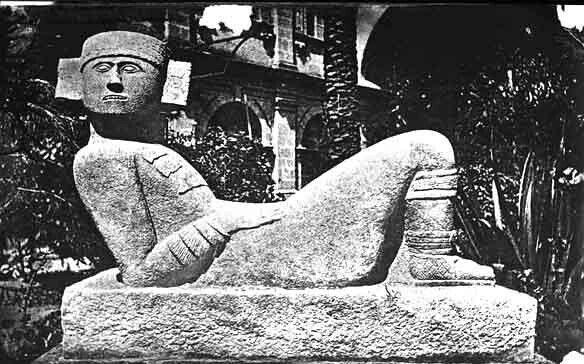
Chacmool excavated by Augustus Le Plongeon (1825-1908) from the Platform of the Eagles and Jaguars at Chichen Itza, Yucatan, 1875
____________________________________________
* The print says Aztec, but it’s a Maya figure from a Maya site
Doodle

Doodle
RoseArt metallic gel pen on 90lb Stonehenge paper
7 1/2 x 5 5/8 inches
Paper Boats Under Full Moon


3/4 x 5 1/2 inches
collage, acrylic, gesso, gel ink, and beads on 140lb Cartiera Magnani hot press watercolor paper
The moons were made from antique silver beads I’ve had for aeons. I salvaged them from an old necklace. The boats are made from vintage onion skin stationery, meant for sending air-mail letters.
Balancing Equations
It took me half the day yesterday just to get it scanned. I would insist on making books that don’t quite fit on the scanner when opened. It’s not hard to stitch the two halves of a spread together, even in my old version of Photoshop, but it’s still an added pain in the ass.
A few of these will be repeats, but I wanted to stick them all together, in order. The entire set, with large versions of the images plus a few more photos of the book itself, can be seen here.
Addendum: You can also click on each individual image to go to that image’s page, then click on that image to view it full sized (for most artwork and photos, that means 1024px wide for landscape format images or 1000px tall for portrait format images).

Front Cover

Wings

Then I Shall Be

To Those Who Know Her Less

Solving for X

Mending Bone

Eclipse

Three Unknowns

The Moon Came Down Too Soon

Fig.42

The First Last

Form of a Radical

But what will our gift be, riding afar,
Our brightest jewel, the Northern Star

Would you dream those were our shadows
Weight in carats, price in dollars

There Have Been Wrecks on Smaller Seas

Left: A tiny “Mayflower” launched on sunlit seas
Right: And the visions faded that now we see

Inflorescence

Three Pennies and Two Birds

Ten Pieces Given

My Annie dear, you lift your eyes
To ask me where the moral lies?

Five Paper Dolls

Cut Away Here

If You Should Get it and Let It Fall

Dancing Hands

Spine

Foredge
Teaser
I’m up to ten new two-page spreads in the Equations art journal, which means I’m about 3/4 done with it. Last weekend, I stumbled across a most excellent book of Victorian poetry–nice and flowery and emotive–and I’m using fragments from it. Also, more paper boats, because some of the poems deal with adventures on the high seas. No pirates, alas.
When I started working in this journal, I thought it would visually be similar to the hemp bound journal. Not so much, it turns out. The first few pages started off in that vein, but it quickly changed direction. For one thing, there is more color (pink, even!), some window cut-outs, and generally less clutter. The pages are more spare and formal, which is as it should be, considering the overall theme.
Anyway, neener-neener! You can’t see any of it until next week, when Mr. Computational Device arrives. Actually, it may be more like next weekend, because it will take me awhile to get it set up.
Plaster and Paper
Still no computer. Still cranky as hell.
Other than that, it was a (mostly) lovely weekend. I got a lot of arting done. I can’t play show-and-tell, so you’ll just have to take my word for it. I’ve been mostly playing around with re-creating the patina on crumbling old plaster walls. It’s actually pretty easy, and involves gesso, Caran d’Ache Neocolors II (other water soluble crayons may work just as well, but I haven’t tried them), and baby wipes. It takes a little practice to blend, then partially remove the color, but it’s not difficult. It helps to periodically refold the baby wipe, because unused portions will remove more crayon than those that are have been clogged with pigment.
I’ve also found that paper grocery bags are excellent foundations for this technique, because of the way they are folded and, after use, slightly crumpled. Even after ironing, the crumples show through the layers of gesso and crayon. The only drawback to using them is that they are not archival. There may be similar papers available that are, but I suspect that it would be difficult to find one that had the same weight and fibrous quality as used grocery bags.


Teach Hiúdí Néill by Seán Ó Domhnaill, published under a Creative Commons Attribution-NonCommercial-NoDerivs 2.0 Generic license
Frustration is: Six two-page spreads in an art journal and no way to share them. So, for now, you’ll just have to make do with beautiful photos of real crumbling walls.
Happy damned Monday, everyone!
[ETA: This originally was illustrated with different photos, which of course have disappeared from Flickr.]
Two More Boats
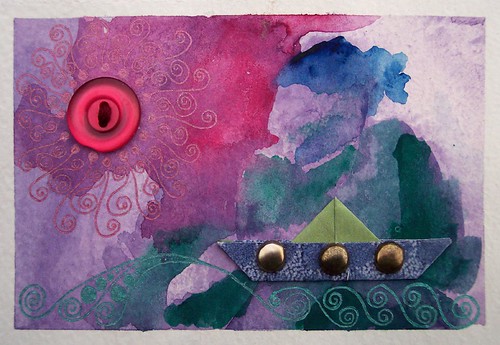
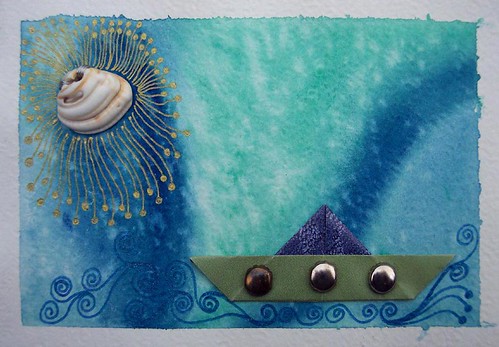
3 3/4 x 5 1/2 inches
watercolor, gel pen, sea shell, button, brass brads, and paper boat on 90lb cold press watercolor paper
Paper Boats


3 3/4 x 5 1/2 inches
acrylic, gel pen, button, brass brads, and paper boat on watercolor paper
I think there is some rule that it must start raining every time I begin to photograph artwork. So, these images are not good, but they’ll have to do for now.
 red paper boat