Ladybusiness

Occasions

Some of the women speak rarely, if ever, of their babies. Lucy is not one of them. I think that’s due to the fact that she was writing letters home to her sisters instead of keeping a regular journal. Her family would surely have wanted news of little Sissy’s progress.

Aside from giving regular updates of her progress in weaning Sissy, Lucy also talked about the baby’s developmental milestones: walking, talking, teething, and potty training. This is the first time I’ve heard the word “occasions” used in this way, and the crudity of the subject matter juxtaposed with the oblique primness of the description made me laugh.

[October 1852]

I have not said a word about dear little Sissy. she is not weaned yet & I guess I shall not do so till spring she does not talk yet & has not run about more than a month She has 8 teeth all cut since she was a year old & strange she cut her eye teeth first She’s a cunning puss knows all we say tell Mrs Wright she has 2 great faults which I am continually whipping her for one is poking her fingers into the bread when set to rise the other is opening my box & sitting on the top of things & twice she did her occasions in it.

Cooke, Lucy Rutledge, 1827-1915, Letter from Lucy Rutledge Cooke to Marianne Rutledge Willis, October, 1852, in Covered Wagon Women: Diaries & Letters from the Western Trails, vol. 4: 1852: The California Trail. Holmes, Kenneth L., ed. & comp. Lincoln, NE: University of Nebraska Press, 1995.
Ladybusiness

Levity

As bad as things could be on the overland trails, there were also rare moments of levity. Lucy always speaks warmly of her husband, and it’s clear from her letters that they shared a strong bond of friendship as well as marriage. I can just about picture him, decked out in her clothes, kicking up his heels.

[June 18, 1852]

The young men all amused themselves with dancing after supper in which Wm joined as hearty as any. the cook of the company we had camped with amused us all much as he had found the previous day a bundle of woman’s clothing which he had put on & had worn it all day, sun bonnet & all it caused considerable merriment all along the road & when dancing came off there was such a demand for this lady for a partner that Wm came for my saque dress & sun bonnet to wear Oh what guys the 2 did look but seemed well to enjoy themselves I sat looking at them till long after dark

Cooke, Lucy Rutledge, 1827-1915, Letter from Lucy Rutledge Cooke to Marianne Rutledge Willis, June 10, 1852, in Covered Wagon Women: Diaries & Letters from the Western Trails, vol. 4: 1952: The California Trail. Holmes, Kenneth L., ed. & comp. Lincoln, NE: University of Nebraska Press, 1995.

Ladybusiness

Vaccination on the Overland Trail

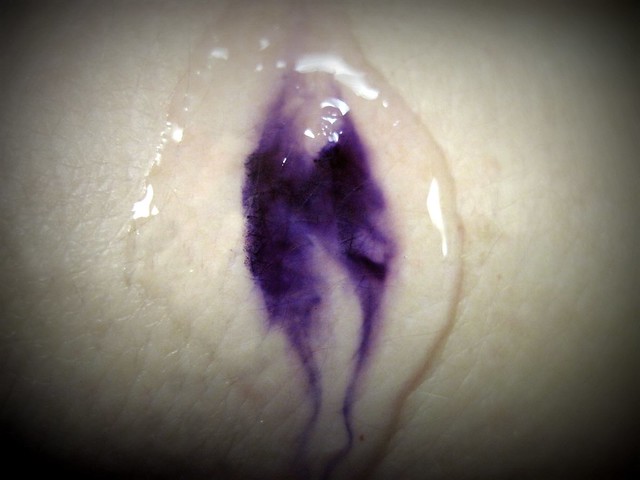
I think this was the first mention of vaccinations in the covered wagon diaries. Which vaccine isn’t stated explicitly, but if Wikipedia is to be believed, it would have to have been for smallpox, because that was the only vaccine in existence in 1852. I’m assuming that what Lucy means is that her daughter was vaccinated by “arm to arm” contact with someone–Richard W.–who had already been vaccinated and had developed pustules around the vaccine site. By rubbing the infected area against the skin of an uninfected person, the second person–Lucy’s dear babe–would then develop a minor infection and so become immune to the disease.

April 19th 1852

My dear babe was vaccinated from Richard W it was only done in one place but it has taken nicely so I’m glad I only had it once R W had 3 & it made his arm dreadful bad. Tell Mrs Wright Ma is not afraid to use cold water at such a time for R W’s arm was in such an inflamation that she had to keep putting wet cloths to it all one night.

Thursday Afternoon

Dear M my little babe is so sick I was up all night with her she takes little or no nourishment & what she does she throws up directly poor babe she moans all the time & is in a high fever We think perhaps it proceeds from her vaccination

Cooke, Lucy Rutledge, 1827-1915, Letter from Lucy Rutledge Cooke to Marianne Rutledge Willis, April 19, 1852, in Covered Wagon Women: Diaries & Letters from the Western Trails, vol. 4: 1952: The California Trail. Holmes, Kenneth L., ed. & comp. Lincoln, NE: University of Nebraska Press, 1995.

Ladybusiness

The Beginning of Trouble

This entry is short and sweet, and it made me laugh. I suspect that eating fried pudding is the beginning of trouble. It sounds repulsive!

April [13], 1852

Started for California amidst the tears and sighs of our friends which is indeed a comforting depression upon our spirits. We find the roads very bad. Went fourteen miles and stopped at a little place called Pavilion [Illinois], rather a romantic name for a few miserable huts. I stayed at a public house and ate fried pudding. This I expect is the beginning of trouble.

Cummings, Mariett Foster, 1827-, Diary of Mariett Foster Cummings, April, 1852, in Covered Wagon Women: Diaries & Letters from the Western Trails, vol. 4: 1952: The California Trail. Holmes, Kenneth L., ed. & comp. Lincoln, NE: University of Nebraska Press, 1995.

Photography

Eggs

IMG_0411

I’ve got a giant jar of pickle juice sitting in the fridge, which means it’s time to make pickled eggs. (You can’t really tell unless you look at the bottom rim of the pan, but the eggs are under water, cooling off. That’s why there are some strange shadows and reflections.)

Uncategorized

Customer Service Win

I sometimes feel a little silly for not taking my car to a quick lube place for oil changes. Instead, I drive 25 miles out of my way to get it done. Which is what I did this morning. When I got there, I told them that I hadn’t checked fluid levels lately, but that I knew the windshield washer fluid was empty. Obviously, I could refill that myself, but for some reason, I just can’t remember to buy any. The mechanic kind of laughed at me, but I can’t help it. I have some sort of mental block.

So, as I was driving home, I went around a twisty curve and heard a THUNK from the floor of the passenger seat. I looked down, and there was a full gallon of windshield washer fluid lying there. How thoughtful! That totally made my day. I really doubt that one of the quickie oil change places would have done that for me, which is why I drive to the next county to get an oil change.

Plus, it’s always nice to go for a drive in the country.

Ladybusiness

Eliza Ann McAuley Egbert

By 1852, the fate of the Donner Party would have been well known to anyone traveling the various emigrant trails. The site of the cabins quickly became a sort of tourist attraction, and so it’s no surprise that anyone going over the same road would take note of it in their diary.

Monday, September 13th [1852]

Very cold this morning, but became quite pleasant when the sun got above the mountain tops. Had very good road this forenoon and nooned in a little valley with excellent grass and water. This afternoon we passed Starvation Camp, which took its name from a party of emigrants, who, in 1846 attempted to reach Oregon by a southern route, but getting belated in the mountains, the snow came on and buried up their cattle. Here they were forced to remain several weeks, and were, it is said, reduced to the terrible extremity of cannibilism, and but six were living when relief came to them. It is the most desolate, gloomy looking place I ever saw. There were the ruins of two or three cabins down in a deep dark canyon, surrounded by stumps ten to fifteen feet high, where they were cut off above the snow.

Donner Lake, a beautiful sheet of water, not far from here, was named in remembrance of the party.

We camped in a small valley, about three miles west of this place.

Egbert, Eliza Ann McAuley, 1835-1919, Diary of Eliza Ann McAuley Egbert, September, 1852, in Covered Wagon Women: Diaries & Letters from the Western Trails, vol. 4: 1952: The California Trail. Holmes, Kenneth L., ed. & comp. Lincoln, NE: University of Nebraska Press, 1995.

So many of the diaries of the covered wagon women are filled with passages about how difficult and exhausting the journey was. Stories upon stories of days upon days spent searching for food and water for their livestock, of fording the same dangerous river five, six, or seven times to avoid treacherous landscapes, and of sickness, starvation, and death among their companions and animals. Some of the diarists show a fair bit of good humor in their writings, but so far none has equaled the following passage in its expression of pure, lighthearted joy over what surely could have been a tragic event. And to think that it happened so near to where others had suffered through one of the worst experiences imaginable.

Tuesday, September 14th, 1852

While the teams were toiling slowly up to the summit, Father, Mr. Buck, Margaret and I climbed one of the highest peaks near the road, and were well repaid for our trouble by the splendid view. On one side the snow-capped peaks rise in majestic grandeur, on the other they are covered to their summits with tall pine and fir, while before us in the top of the mountains, apparently an old crater, lies a beautiful lake in which the Truckee takes its rise. Turning our eyes from this, we saw the American flag floating from the summit of one of the tallest peaks. We vented our patriotism by singing “The Star Spangled Banner” and afterward enjoyed a merry game of snow ball. Turning to descend, the mountain side looked very steep and slippery, and Margaret and I were afraid to venture it. Father, who is a very active man for his age (about sixty) volunteered to show us how to descend a mountain. “Just plant your heels firmly in the snow, this way,” he said, but just then, his feet flew from under him and he went sailing down the mountain side with feet and hands in the air. After a minute of horrified silence we saw him land and begin to pick himself up, when we gave way to peals of laughter. We found an easier way down and rejoined the train, and tonight we camp in Summit Valley on the western slope of the Sierra Nevadas, and are really in California.

Egbert, Eliza Ann McAuley, 1835-1919, Diary of Eliza Ann McAuley Egbert, September, 1852, in Covered Wagon Women: Diaries & Letters from the Western Trails, vol. 4: 1952: The California Trail. Holmes, Kenneth L., ed. & comp. Lincoln, NE: University of Nebraska Press, 1995.