I don’t know where I’ve been the past couple of years, but I’ve totally and completely missed the issue of Flickr NIPSAing users who post predominantly non-photographic images in their public photostreams. If your account is found to have fewer photographs than non-photographs, Flickr can (and often does) mark it NIPSA (Not in Public Site Areas). You won’t know this has happened, because Flickr will not notify you. You’ll just notice that your view stats decrease. The only way to know if your account has been NIPSAed is to check the Everyone’s Photos page. If you get a message there explaining why your photos aren’t showing up, then you’ve been NIPSAed.
Why is being NIPSAed a big deal? Flickr is a social site. The point of belonging is to share your images with others, and to look at their images. If you are NIPSAed, your images will not show up in other people’s searches. They can only access them directly. Nor will your images be visible to others when you post them to your subscribed pools.
I have mostly photos in my photostream, so I think I’m probably safe, but who knows? It boggles the mind, but Flickr does not actually have an explicit written policy on the subject. Their Terms of Use merely states:
Your account will also be terminated if it is used for hosting graphic elements of web page designs, icons, smilies, buddy icons, forum avatars, badges and other non-photographic elements on external websites.
What that says both literally and in spirit is that they don’t want their service to be used as a place to host junk images that will be displayed elsewhere. There is nothing ambiguous about it. What it does not say, however, is that non-photographic images are not to be uploaded to Flickr, or that those who do so will have their accounts excluded from public view. Nor does it spell out what percentage of images should be photos vs. artwork, and what will happen if you exceed the art quota.
Some of those things are addressed in the Flickr FAQ, as has been pointed out ad nauseum by Flickr employees on their message boards. The problem is, an FAQ is not a TOA. When I subscribed to the service, and when I ponied up the quite reasonable $24.95 for a pro account, I read the TOA. I did not read the FAQ, nor am I required to. The FAQ is merely a list of questions and answers, and I am not bound by anything in it.

Part of the problem is that to create such a specific policy, Flickr would have to define what a “photograph” is. Don’t laugh, it’s not as easy as you might think.
From Dictionary.com:
photograph
noun 1. a picture of a person or scene in the form of a print or transparent slide; recorded by a camera on light-sensitive material
verb 1. record on photographic film; “I photographed the scene of the accident”; “She snapped a picture of the President” 2. undergo being photographed in a certain way; “Children photograph well”
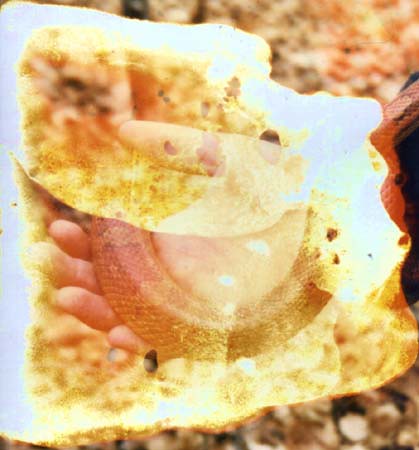
Well, where does that leave digital images? I suppose one might stretch the point, and describe magic pixels as “light-sensitive material.” Still, once you move into the digital realm, jpgs are jpgs. What makes one jpg a “photo” and another “not-a-photo”? Is a traditional photograph that’s been scanned still a photo? Is a digital image of a work of art a photo? One example given in one of the Flickr forums was a drawing on paper vs. a drawing on someone’s hand. You might be tempted to describe the first as art and the second as a photo, but what if you cropped Image A so loosely that the surrounding space becomes integral to the image? Or what if you cropped Image B so tightly that the support (skin) becomes unimportant? Is the image above a photograph, or is it art?
Muddying the waters further, Flickr staff were quick to point out that taking a photograph of a piece of art does not qualify it as a photograph. It’s still art. So are photographs of paintings in museums considered art or photos? What about a photo taken of a large piece of sculpture? Do the thousands of photographs that artists like Christo take of their work qualify as art or photo? Is a picture of a Medieval cathedral art or photography?

What about photographs that have been heavily manipulated, either in a digital imaging program or by hand? Does bleaching a traditional photo make a difference? What about drawing on it? When using Photoshop filters on a digital image?

I don’t know what any of this will mean, long term. At this point, I don’t think I’ll renew my pro account when the time comes. My web host recently doubled my bandwidth and disk space, which were both obscenely huge to begin with, so I’ve got plenty of my own space. And, nearly everything I upload to Flickr is uploaded to my website, too. I don’t see any point in investing any more money or time into something that could well be made unusable to me at any moment. And that’s the problem. Right now, Flickr’s unofficial policy seems to be “more photos than non-photos is okay,” but that could change tomorrow. Going to another service, like deviantART, which is what Flickr staff recommended artists do, is not acceptable to me. I don’t like deviantART. It’s clunky and has none of the social aspects I enjoy about Flickr. Likewise, just hiding all my images from public view–another solution offered by Flickr staff–will not work for me.

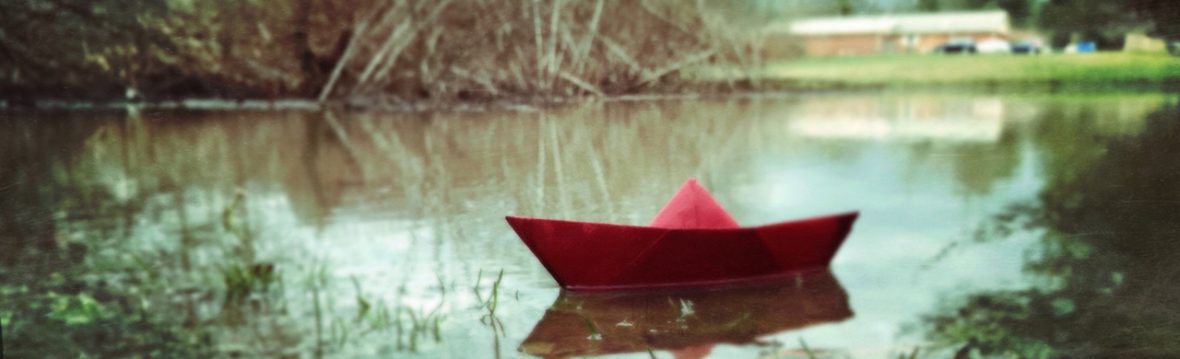
 red paper boat