Ladybusiness

Little House on the Prairie

We’ve all seen the Little House on the Prairie television series.  I grew up with it, and with the books.  I thoroughly and (mostly) unreservedly loved both.  It’s been years since I’ve seen the series, and I missed the Disney miniseries that aired a couple of years ago.  When I was in high school, my Little House books were lost in a move, so it’s been even longer since I’ve read them.  Via the magic of Netflix, I’ve been able to watch not only the Disney miniseries, but the original series and its pilot, and I have some rambling and disjointed thoughts and observations.
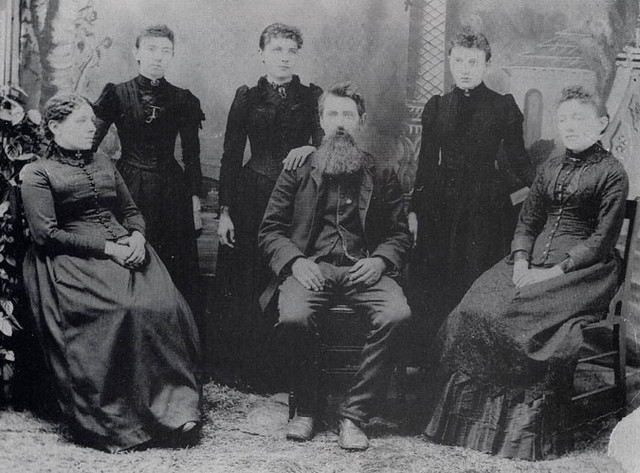
Ingalls Family
Left to right: Caroline, Carrie, Laura, Charles, Grace, and Mary Ingalls

I don’t have satellite or cable TV, and my TV reception is not good enough to get ABC, so I did not see the 2005 miniseries when it aired.  I didn’t even know it existed, until I searched Netflix for the original series.  I watched the miniseries, and was impressed with it.  The sets, costumes, and actors were wonderful.  The script was pretty good, and coincided fairly well with my recollection of the books.  I don’t know how true to history the depiction of the Osage was, but it was believable.   My only quibbles, and they are small, are that the music and the new age crap were out of place.
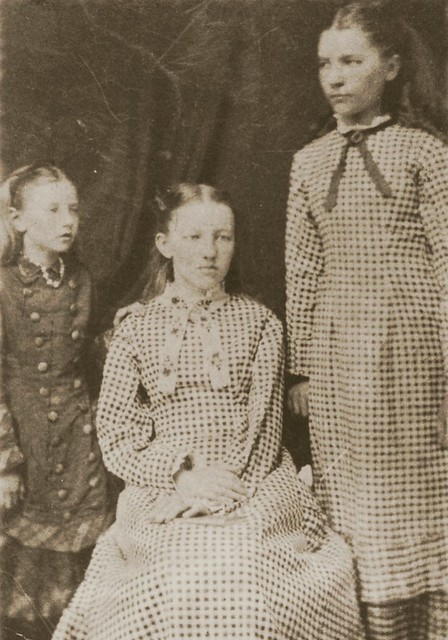
Carrie, Mary, and Laura Ingalls
Left to right: Carrie, Mary, and Laura Ingalls, circa 1894

Jack, who was a bulldog in real life (the 19th century bulldog was most closely related to today’s Pit Bull), was depicted as an Australian Shepherd.  There was a subplot that revolved around Jack’s bicolored eyes.  Allegedly “Indians” called such dogs “spirit dogs” and feared them, which accounted for the Ingalls not being attacked by the local Indians.  Um, no.  Also, the “Enya on the Prairie” music was horribly out of place.

I went online and hunted up some critiques of the miniseries.  It was a mixed bag, with some folks feeling it stuck more closely to the books than the original series and others feeling it had strayed too much.  Interesting.  There was pretty universal praise of the depiction of the Osage and universal condemnation of the new agey bits.  So, my reactions were not out of line.

There was also criticism of which bits of the Ingalls story the creators decided to focus on.  Some folks quibbled with the decision to leave Carrie out of the picture (she was born while the family was in Kansas territory).  Others felt the miniseries should have shown the later parts of the Ingalls’ lives, after they’d left Kansas territory and moved to Minnesota.  They didn’t like that the miniseries did not follow the same plot line as the original series.
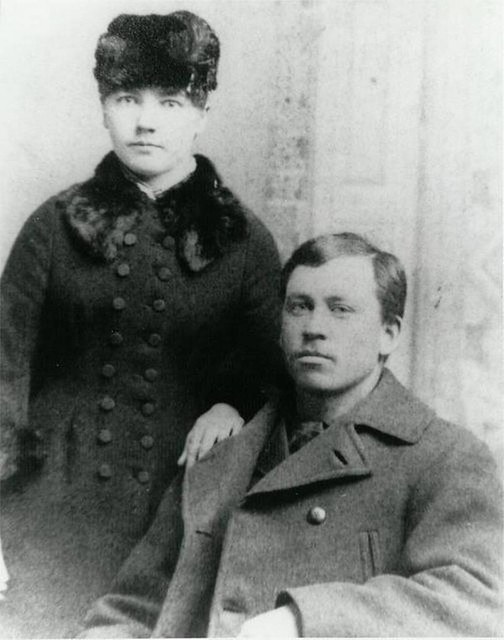
Laura Ingalls and Almanzo Wilder
Laura Ingalls and Almanzo Wilder, circa 1885

Now for the interesting (to me, at least) part.  I next watched the original pilot.  I’d never seen it before, and assumed it would cover the family’s move to Plum Creek.  Nope.  It followed the exact same story line as the 2005 miniseries.  In fact, the majority of scenes in the new shows followed the old pilot almost identically.  The main differences between the two was the reason given for the family leaving Kansas territory and the depiction of the Indians.

In the pilot, the family were forced off their land because the government re-negotiated its treaty with the Indians, and the family were on the wrong side of the new boundary.  In the 2005 miniseries, the family were accused by settling the land illegally, without having filed a proper claim.  I don’t recall which is true; maybe neither is. I’m not sure it really matters much in terms of the telling of a successful story.  (And, that’s what the original books were.  They were stories, not strict autobiographies.)

The handling of the Indians differed between the two series, as well.  In the original pilot, they are treated as flat characters.  They’re just generic mid-70s teevee Indians. Caricatures.  In the 2005 miniseries, the Indians are more completely depicted.  They are families with children as well as a nation facing pressures and conflicts both within and without.

One thing that struck me anew while watching all the incarnations of the stories is the breadth and depth of the role pioneer women played.  They weren’t just meek and mild cooks and child tenders.  They helped build houses, plough fields, and harvest food.  And they did it in corsets and several heavy layers of clothing, even when the weather was blisteringly hot.  These women were no delicate flowers.  If they had been, their families would have never survived, much less flourished, under such harsh conditions.

So, anyway, now I’m working my way through the original series.  I’m about half-way through the first season, and it’s just as charming–and ham-fistedly cheesy–as I remember it being. It’s good, good stuff.

Charles Ingalls and Caroline Quiner

Caroline Quiner and Charles Ingalls

I included photos because I found them fascinating when contrasted against today’s popular representations.  Doesn’t Pa resemble Abe Lincoln in that last photo?

Crankypantsing, Ladybusiness

Yoplait Sucks

Why does Yoplait suck? Well, there are a lot of reasons, starting with the fact that it is overly sweet and of a mucous-like consistency. I personally find the taste and texture to be thoroughly offensive; however, they are not as offensive as Yoplait’s newest commercial. In it, Yoplait asks you, the consumer, to consider their yogurt as a tool in your perpetual weight loss arsenal. Cuz, you know, all women are always on a diet because all women are fat and disgusting, no matter how objectively UN-fat they might actually be.

Case in point: the woman in this Yoplait commercial. She’s so thin that the daylight shining from between her thighs is nearly blinding, and she has a washboard sternum. But, yet, she’s so scared of her big, fat ass being seen in public that she eagerly subjects herself to Yoplait Candied Snot.

Crankypantsing, Ladybusiness

Make it Sto-o-o-p

As I’ve spent the afternoon transcribing more letters, and have had the teevee on in the background, I’d like to take a moment to share a few words about commercials.

First, KFC needs to pull the plug on their new “Music to a mother’s ears” ad. It features a family sitting around the dining room table, chowing down on crispy, chickeny goodness. The idea is that A) shutting the hell up is what a mother wants her family to do and B) the noise of people smacking, chewing, and swallowing is preferable to that of normal dinner conversation. Not only is the premise bizarre, but the smacketty-smack sounds of folks eating is sickifying. And, need I add that it’s something that even my uber-lax mother would not have tolerated at the dinner table? Not only is it all sorts of bad manners, but KFC (and Hardee’s) really ought to rethink their plan to entice diners by inducing them to vomit. Somehow, that doesn’t seem like a very good business plan to me.

O ick!

Second, an old anti-smoking commercial is currently being recycled. I don’t know if these are Indiana-specific, or if they’re being run nation-wide, but there’s a whole series of similar ads. This one begins with a music box-like tune tinkling away as a mother straps her young daughter into a car seat. We see the kid sitting in her car seat. Then, the mother gets into the car and the camera pans to the rear-view mirror, where we see the child looking back at us. The expression on the child’s face throughout the commercial is unreal. The first time I saw the ad, I thought it was a PSA about mentally disabled kids. The depiction of the child is so distracting that I have a difficult time even registering that the commercial is about smoking. Now, I assume that they were going for a china doll sort of concept, in order that the viewer understand that the child is helpless; but, they’ve gone too far, making the kid look so vacant and vacuous that the point of the sermonizing is pretty well lost on me.

Ladybusiness

Homestead Women

[Edited to add video and update broken links 16 Oct 2015]

A few months ago, I stopped at the Mission thrift shop and picked up a stack of old medical and high school text books. My intention was to use them for art projects, either altering them or using the illustrations in collage work. Because I’m still suffering from a lack of motivation, I spent some time this morning leafing through them, and came across this photo of four sisters who made a homestead claim in Nebraska Territory. The book is old and the print quality is poor, but I thought I’d scan and share it anyway.

I’ve been doing a lot of thinking about contemporary popular assumptions about the roles women played in the settling of this country. I suspect that women, like these four sisters, were not the dainty flowers that we are led to believe they were. Although it wasn’t common, women were legally able to file for Homestead claims as head of household. And, they did. Homesteading was back breaking work. It involved building a home by hand, planting and harvesting crops, and improving the land, in a wild and isolated environment. The women below look like they’re made of stern stuff. I hope they succeeded, but the reality is that many homesteaders ended up failing and having to forfeit their claims.

Women Homesteaders
Caption: They built “a little sod shanty on a claim.” The four sisters shown below claimed land in Custer County, Nebraska under the Homestead Act of 1862. There were few trees on the Great Plains so the pioneers had to build shelters of earth or “sod.” — Image and text from Moon, Glenn W. and John H. MacGowan, Story of Our Land and People. NP: Henry Holt and Company, 1955. (LC card catalog number: 55-5854.)

Addendum: Holy crap! Ask and ye shall receive, I guess. I did a little Googling, and came up with a link to women homesteaders in Nebraska. And, guess what? The above photo is of the Chrisman sisters. It was taken on June 14, 1886 by Solomon D. Butcher.

The Chrisman sisters lived near the Goheen settlement on Lieban Creek in Custer County. Lizzie Chrisman filed the first homestead claim in 1887. Lutie Chrisman filed her claim the following year. The sisters took turns living with each other so they could fulfill the residence requirements without living alone. The other two sisters, Hattie and Jennie Ruth, had to wait until they came of age to file. All the land was gone before the youngest sister was old enough to file, but all four were well-known members of the community.

Ladybusiness

More Thoughts on Control

Recently, there seems to be a recurring theme in several of the online fora I read–from blogs to mail lists to newsgroups–wherein someone in possession of unflattering private information about another person decides to share that knowledge publicly. I can only think of one purpose for doing so: it is a form of punishment. It’s a way for the aggressor–and it is an act of aggression–to get back at the aggressee by publicly humiliating her for being noncompliant.

On the surface, it may seem like a small thing–just one person getting a jab in at another’s expense. That’s the insidious beauty of it, though, because what lurks beneath is, I think, pretty heinous. The underlying motivation comes from the aggressor recognizing that he has lost control of the aggressee. Public shaming is then called upon to bring the wayward party to heel. Moreover, the aggressor can do this while presenting himself as the victim. Flawless victory! It’s perfect, because it not only allows the aggressor to bully himself back into a position of control, but it also dehumanizes and devalues the aggressee in the eyes of others.

Except that that’s not always the case. Sometimes, folks see through the ugly little charade, and when they do, the true aggressor and aggressee are pretty easy to identify.

Ladybusiness, News & Politics

Family Values in the Culture of Control

Via Feministing.

Apparently, in the city of Black Jack, you must conform to a specific standard of “family” or you’ll be run out of town. According to a CBS News article, city council members in the Missouri town have “rejected a measure allowing unmarried couples with multiple children to live together. The mayor said those who fall into that category could soon face eviction.” The couple has three children in common, yet the city council refuses to grant them permission to live together. Since when is the government in charge of telling folks what forms their families must take? Since when is it appropriate to force families to choose between housing and staying together?

This bit made me laugh (It’s funny, cuz it’s true!):

In the statement, McCourt said, “the city provides information about its occupancy permit requirements to anyone who requests it. … As mayor, I am required by state law to uphold the laws of the city of Black Jack.”

Mr. McCourt is apparently familiar with his Douglas Adams:

‘But Mr Dent, the plans have been available in the local planning office for the last nine months.’

‘Oh yes, well as soon as I heard I went straight round to see them, yesterday afternoon. You hadn’t exactly gone out of your way to call attention to them had you? I mean like actually telling anybody or anything.’

‘But the plans were on display …’

‘On display? I eventually had to go down to the cellar to find them.’

‘That’s the display department.’

‘With a torch.’

‘Ah, well the lights had probably gone.’

‘So had the stairs.’

‘But look, you found the notice didn’t you?’

‘Yes,’ said Arthur, ‘yes I did. It was on display in the bottom of a locked filing cabinet stuck in a disused lavatory with a sign on the door saying Beware of the Leopard.’ A cloud passed overhead. It cast a shadow over Arthur Dent as he lay propped up on his elbow in the cold mud. It cast a shadow over Arthur Dent’s house. Mr Prosser frowned at it. ‘It’s not as if it’s a particularly nice house,’ he said. ‘I’m sorry, but I happen to like it.’ ‘You’ll like the bypass.’ ‘Oh shut up,’ said Arthur Dent. ‘Shut up and go away, and take your bloody bypass with you. You haven’t got a leg to stand on and you know it.

Ladybusiness, News & Politics

On Press Bias

There was much frothing and agitation yesterday in response to a WaPo article on the CDC’s new recommendations for preconceptive health care.

Going by the WaPo article, it would appear as if Margaret Atwood’s worst nightmare might be blossoming before our eyes. Any woman capable of bearing children–whether or not she intends to become pregnant–should not drink or smoke or have contact with cat feces, should take folic acid and vitamin supplements, maintain a “healthy” weight, keep conditions like asthma and diabetes under control, etc. Basically, women should pretend that they might become pregnant at any moment.

If true, the recommendations would certainly be something to get uppity about. It’s one thing to tell women that X behaviors are good or bad their health. It’s quite another to focus on the potential health of a hypothetical fetus, as if the woman’s health, in and of itself, were unimportant. By all means, tell women that they ought to take care of their health, but that message should not be contingent on their fertility status. Thankfully, that’s not at all what the CDC was recommending, though. The CDC recommended that any woman who intends to become pregnant should follow their guidelines. That’s quite another kettle of fishes. It’s still a little troubling, because it ignores the impact of men’s health on fetuses, but it’s a long way from calling for all women to be treated like ambulatory incubators.

I don’t know what the hell WaPo was thinking, but this is a pretty good example of how the press can twist something around until it says almost the opposite of what the original source intended. News outlets are run by humans, and humans have agendas. It always pays to be skeptical, and to, whenever possible, consult original sources. If you cannot access the original source, then you should attempt to find a variety of view points on the subject. Otherwise, someone might try to sell you some prime swampland in Poughkeepsie.

Crankypantsing, Ladybusiness

If you can’t see my hands…

Since I’m on the subject of drivers, I figured this was as good a time as any to discuss Mr. DeWitt. He taught drivers’ ed., health, and, I believe, phys. ed. I had him for drivers’ ed. and health.

Mr. DeWitt was deeply bizarre. He was infamous for telling stories about his family. And retelling them. And retelling them. I think I might have stuck an ice pick in my eardrums if I’d had to sit through one more quarter with his stories. If it wasn’t the story about how his daughter got a nose job and now she was just as cute as a button, it was the story about getting shot at for stealing watermelons when he was a teenager. There was also the one about his alcoholic brother, or maybe it was his cousin the speed freak? I suspect he was making most of them up, hoping that adding a personal touch to the cautionary tales would lend them importance. The condom and banana routine that Andy mentioned in comments was an oldie but a goodie. He also brought in life-size anatomical models of male and female genitalia and passed them around. Probably not a bad idea in itself, but lordy, was he ever creepy about it.

Drivers’ ed. was a whole ‘nother kettle of fishes. I was so sick of his stories that I skipped class more often than not. Funnily enough, it didn’t affect my grade. In class, he told the same old stories and spewed the same old one-liners (“If you can’t see my hands, you gotta wonder what I’m doing!” being the most repeated.) On driving days, he was fond of taking us out onto the bypass, waiting until we’d gotten somewhat comfortable with the speed and traffic, then yelling “SHAZAAM!” in our ears. That did not go over very well with me. I pulled off the road and told him that if he ever did that again, I’d walk home, and he’d have to explain why he came back minus one student.

The first day my group actually drove, he took us to a cul-de-sac to practice. My one and only driving lesson at that point had been in an ancient VW squareback that not only was temperamental as all hell, but also had a broken driver’s seat. I had to sit on a couple of phone books, my feet barely touched the pedals, and I had to sit upright, because the back of the seat was permanently reclined. So, when I first tried to drive the drivers’ ed. car, I naturally gave it too much gas and hit the brakes too suddenly. Power brakes? WHAT FRESH HELL IS THIS? Mr. DeWitt’s response was that we should drive the car like we were having sex–nice and slow. Now, how the hell is that an appropriate thing to say to a car full of teenage girls?

He was also fond of grabbing the driver’s seat belt, ostensibly to make sure it was correctly adjusted. It was obvious, though, that he was just copping a feel. There is no reason on earth why he would need to put his hands between a girl’s breasts in order to determine whether or not the seat belt was adjusted properly. I’m just sayin’…

The best, though, was when we picked up our waivers. He made each of us come to his office to pick them up, instead handing them out in class. When I picked up mine, he told me all the girls had to give him a hug before he’d give them their waiver. I said, “Okaythenbye!” and turned around and left. No way in hell was I giving Mr. PervyPants a hug. He apparently thought better of it, and followed me down the hall and handed the waiver to me. Hrmph.

So, it’s no wonder I have an ambivalent attitude toward driving. I ended up spending all my drivers’ ed. time trying to think of ways to avoid the teacher, instead of actually learning how to, oh, I dunno, drive.

Ladybusiness

Friend of the Fetus

Lyrics reposted from http://sniff.numachi.com/~rickheit/dtrad/pages/tiFRNDFETS.html

Friend of the Fetus
(Carol Rose Livingstone)

1. I am no friend of the fathers and mothers
I am no friend of the sisters and brothers
I am no friend to the weak and distressed
I am no friend to the poor and oppressed.

Chorus
But I am a friend of the fetus,
A friend of incomparable worth
I am a friend of the fetus,
Right up to the moment of birth.

2. Once it’s a baby I will not go near it,
I will not feed it and I will not rear it.
When it is crying I won’t even hear it
For I have no room in my heart for a human.

3. I will not weep for it, I won’t lose sleep for it,
I will not care for it, I won’t be there for it,
I’ll walk away from it, I won’t go grey for it
I will not pray for it and I won’t pay for it.

JB

Ladybusiness, Pets, Photography

Sunday Dogblogging and an Instant Review

000_0027

Harriet often sits upright on the couch, with her paws on her belly, like a little old man watching television. This time, her left paw was strategically placed, which cracked me up, so I got out the camera.

Instant Review: An American Haunting

Ms. Lea, D, and I went to see An American Haunting last night. I just wanted to see a movie–it didn’t matter which one, as long as Tom Cruise wasn’t in it. I like horror and ghost stories, so An American Haunting sounded good to me.

It is allegedly based on a true story, and I had done a little reading ahead of time on the story and various explanations for what had happened. The first 2/3 of the movie seemed to follow the general storyline fairly faithfully: The father pisses off a neighbor in a land deal gone wrong. The neighbor is thought to be a witch. She curses the family. When a series of strange occurrences plague the family, they blame the neighborhood witch. Most of the haunting involves tormenting of the family’s daughter, then, later, the father.

But then, the movie took a bizarre right turn. Instead of the common assumption that the neighbor was responsible for the haunting, the movie storyline involved the father molesting the daughter, who then had some sort of psychotic/supernatural split. It was the daughter who was responsible for the haunting. Why she would have spent years tormenting herself is a mystery to me. Perhaps it was a passive-aggressive way to get back at her father? In any event, the daughter does end up getting her revenge on her father, by goading her mother into poisoning him. After the father’s death, the haunting ceases.

I didn’t get obsessive about doing pre-movie research, so I could’ve missed some theories, but nowhere did I come across a father-molesting-daughter theory. And, while there was some set-up for that conclusion, it ended up feeling abrupt, like it had been tacked on at the last minute.

I do wonder if the daughter might have been epileptic. In the early 1800s, when the haunting took place, it was thought that epileptics were possessed by spirits. Exorcism was a common “treatment” for the disease. It may have been preferable to make one’s community believe you are the victim of a haunting than to admit that your daughter was possessed by evil spirits. Someone with epilepsy might have been blamed for all sorts of bad happenings, so deflecting the blame onto a neighbor would have been a stroke of PR genius.